The King’s Table: How Persian Cuisine Forged an Empire
A royal feast in ancient Persia was far more than a meal; it was a stage where politics, ritual, power, and courtly rivalries unfolded amidst the aromas of saffron, roasted meats, and ceremonial drinks. From the ritual cauldrons of the Elamites to the opulence of the Qajars, food was a language through which kings governed.
This journey through Iran’s royal kitchens reveals how dishes we consider ordinary today were once exclusive to the tables of kings. The story of the Persian royal table is one whose flavors and significance still rise from the pages of history.
The Elamites: The First Royal Tables of the Iranian Plateau
The Elamites possessed one of the oldest civilizations with an “organized kitchen” in Iran. Excavations at Susa have uncovered large stone and earthenware pots, indicating that food was a central part of religious and royal ceremonies.
For the Elamites, the king’s dinner was akin to a religious rite; the king consumed his meal as an offering to the gods. The royal diet was both energizing and sacred, featuring dense wheat and barley dishes, fermented drinks with aromatic herbs, game meat like wild goat and boar, and bread baked in hot ashes.
The Medes: The Table of Mountain Warriors
Life for the Medes was semi-nomadic and warlike. Their table was simple yet powerful, designed to provide strength, health, and military readiness. Royal meals consisted of roasted sheep and goat meat, thick rustic breads, mountain herbs, onions, garlic, and light fermented drinks. Historical accounts note that the Median king ate his food “without pomp” but “in sufficient quantity.” For the Medes, strength was more important than splendor.
The Achaemenids: Stews for an Empire
With the Achaemenids, food entered an era of systematic state management. Tablets from Persepolis record food rations for everyone from the king to laborers, including mutton, barley bread, thick yogurt, and dried fruit. At the court of the Shahanshah, a more luxurious version of these same staples was served. Food in this era was a tool of “soft power”—a means to purchase loyalty and forge soldiers.
The Sassanians: The Dawn of Persian Royal Opulence
In this period, food transitioned from pure function to elaborate ceremony. Historical sources describe magnificent dishes such as stuffed lamb, chicken cooked in milk, oily and fragrant breads, saffron-infused halva, and honey-sweetened beverages. The Sassanian king would sit while courtiers served him with strict order and nobility. The royal table was an integral part of the “sanctity of kingship.”
The Safavids: When Iranian Cuisine Forged a National Identity
The Safavids are the architects of modern Iranian food culture. During this era, kebabs, rice dishes, saffron-infused stews, and herb-based recipes took on a coherent and distinct form. The table of Shah Abbas was legendary; when hosting foreign guests, 30 to 60 different dishes would be served. The Safavid table was a formal display of “national power.”
The Qajars: An Era of Culinary Extravagance and Display
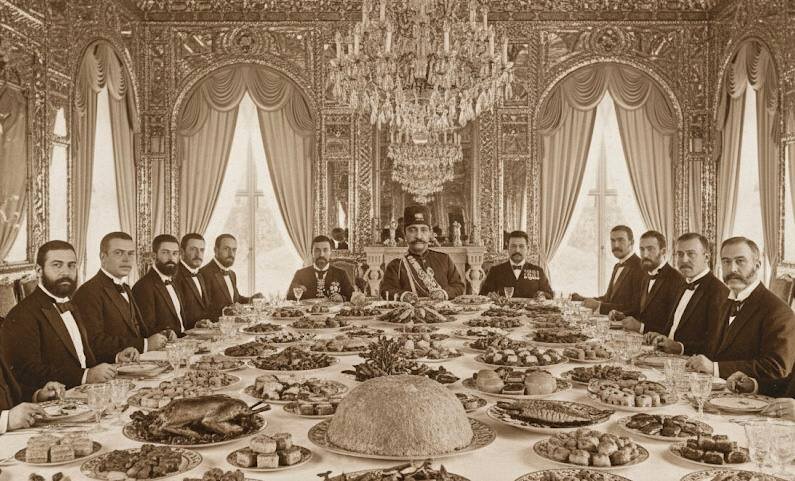
Detailed reports from the Qajar era abound. Nasser al-Din Shah had a great love for food, and cooking in his court was a complete industry. The royal spread was a spectacle of power, featuring dishes like fesenjan with duck, elaborate rice dishes (tahchin), heavy biryanis, fish from the Caspian Sea, massive kebabs, and traditional sweets. Every plate was meant to proclaim the grandeur of the court.
Cuisine as a Tool of Statecraft
The profound importance of food for Persian kings was its role as a representation of the monarchy itself. An invitation to the table was a grant of privilege and influence. The quality of the food demonstrated the wealth and order of the court, and even the arrangement of the table setting carried a political message. Through the language of cuisine, Persia’s rulers nourished not only their courts but the very foundations of their empire.