Title: Heightened Tensions: US Weighs New Measures in Caribbean as Venezuela Stands Firm
Introduction: A New Phase of Pressure
In a significant escalation of Washington’s pressure campaign against the government of Venezuelan President Nicolás Maduro, four US officials have indicated to Reuters that the United States is preparing to initiate a new phase of operations related to Venezuela in the coming days. This development comes amidst a long-standing military buildup in the Caribbean and follows a recent Federal Aviation Administration (FAA) warning to airlines about a “potentially dangerous situation” when flying over Venezuelan airspace.
An Impending Operation
Reports of imminent action have intensified in recent weeks as the US military has deployed forces to the Caribbean Sea and diplomatic relations with Caracas have continued to deteriorate. According to two of the US officials, covert operations are likely to be the first component of this new action against the Maduro administration.
A senior US official, speaking on Saturday, ruled out no options regarding Venezuela, stating, “The Trump administration is prepared to use all instruments of American national power to counter the illicit drug trafficking and bring those responsible to justice.” The US administration is examining a range of options to counter what it describes as Maduro’s role in supplying illegal narcotics to the United States—an allegation Maduro has consistently denied.
Strategic Options and Diplomatic Channels
The United States plans to designate the ‘Cartel of the Suns’ as a foreign terrorist organization on Monday due to its alleged role in importing illegal drugs. The Trump administration has accused President Maduro of leading this cartel, a charge he refutes.
US Secretary of Defense, Mark Esper, stated last week that this designation “gives the US government a whole new range of options.” While President Trump has suggested this action allows the US to target Maduro’s assets and infrastructure within Venezuela, he has also spoken of a potential willingness to negotiate for a diplomatic solution. Two US officials confirmed that backchannel communications between Caracas and Washington are ongoing, though it remains unclear what impact, if any, these talks will have on the timing or scope of any US operations.
Military Posturing and Asymmetric Responses
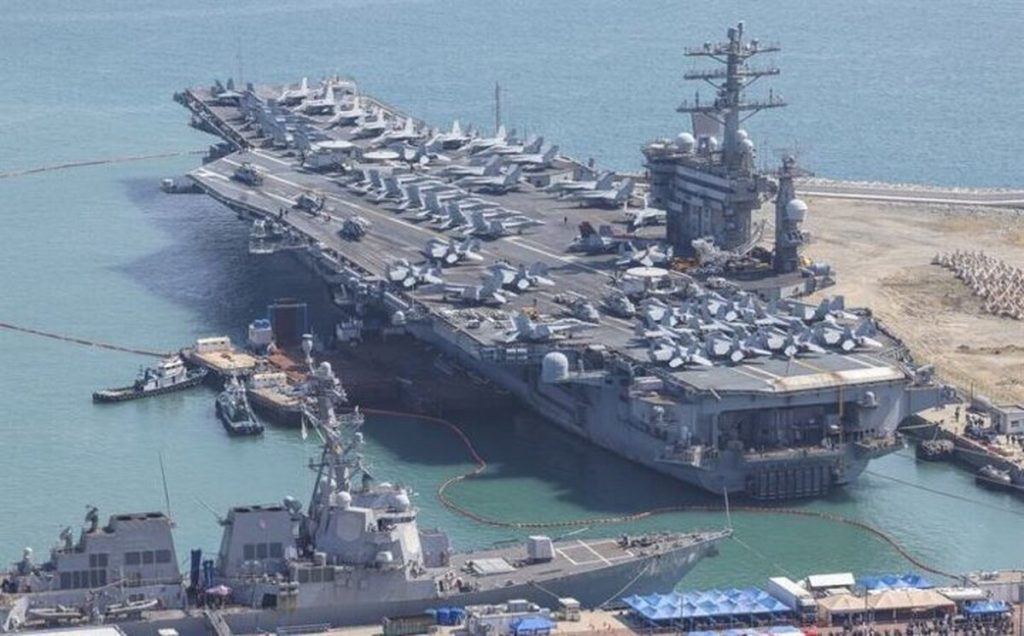
Simultaneously, the USS Gerald R. Ford, the US Navy’s largest aircraft carrier, entered the Caribbean on November 16th with its carrier strike group, joining at least seven other warships, a nuclear submarine, and F-35 fighter jets. While US forces have so far focused on counter-narcotics operations, the scale of the assembled force is noted to be significantly larger than what would typically be required for such missions.
In response to the pronounced military disparity, the Maduro government is reportedly preparing for alternative strategies in the event of a potential US incursion. State television has discussed a plan for a “long-term resistance” involving a “guerrilla” response. This approach would reportedly deploy small military units across more than 280 different locations to carry out sabotage and other guerrilla tactics.
Psychological Operations and Political Calculations
According to reports, the White House has recently floated the idea of US military aircraft dispersing leaflets over Caracas—a psychological operation designed to increase pressure on President Maduro. Informed sources suggested a potential timing for such an operation could have coincided with Maduro’s birthday, though it has not been officially confirmed. This would represent a new level in Washington’s pressure campaign.
The Trump administration has asserted to Congress that the US is engaged in an “armed conflict” with designated terrorist organizations, a claim that has drawn criticism from some lawmakers. President Trump stated in mid-November that he had “largely made a decision” on how to proceed regarding the potential for military action in Venezuela. Leaflets reportedly prepared for distribution included information on a multi-million dollar reward for information leading to Maduro’s arrest and conviction.
The United States, along with more than 50 other nations, does not recognize Maduro as the legitimate leader of Venezuela, asserting that he lost the 2018 presidential election. The potential use of leaflet drops is a standard psychological tactic aimed at undermining morale and encouraging opposition, representing a step considered less severe than direct military engagement.