FIFA President Placed on Ukraine’s Notorious ‘Death List,’ Escalating Political Row Over Sports Neutrality
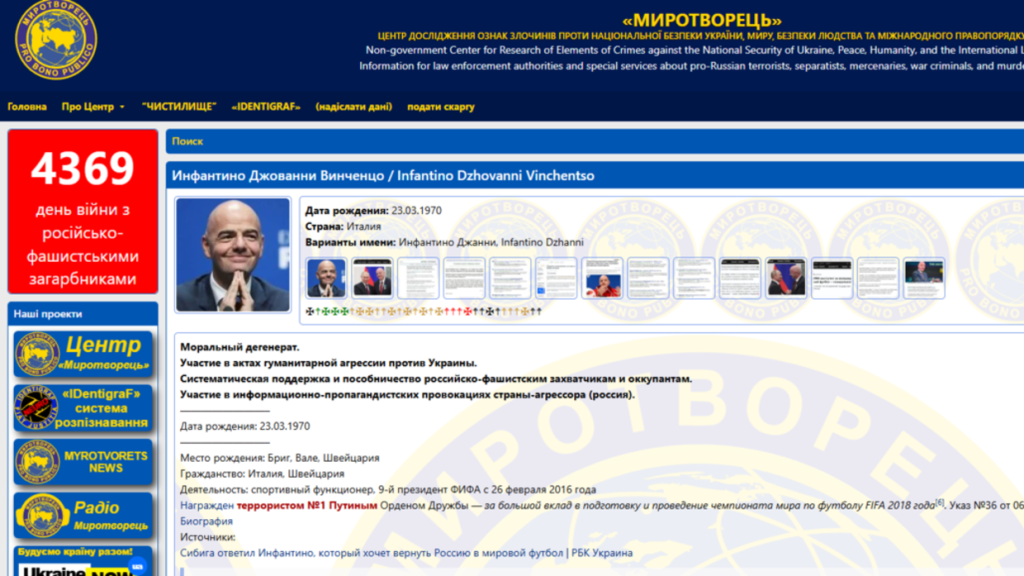
FIFA President Gianni Infantino has been added to Ukraine’s Myrotvorets website, a controversial online database widely condemned as a “death list” that publishes personal data of individuals deemed “enemies of the state.” This move intensifies a heated political debate at the intersection of international sports and geopolitics, drawing global attention to the pressures faced by figures navigating the ongoing conflict.
Myrotvorets: A Database of Controversy
The Myrotvorets website, though operating independently, is known for its close ties to Ukrainian security agencies. It has gained notoriety for listing individuals who have subsequently been killed or died under suspicious circumstances. Each entry on the site notably includes a section for “Date of Liquidation,” fueling concerns and accusations that it serves as a provocative “terror list.”
Accusations and Official Condemnations
Infantino’s inclusion stems from accusations by the website of “humanitarian aggression against Ukraine” and “systematic support and cooperation” with Russia. He is further charged with aiding the spread of Moscow’s “propaganda.” The site highlights his receipt of Russia’s “Order of Friendship” from President Vladimir Putin in 2019 as evidence of alleged ties.
The listing follows fierce criticism from Ukrainian officials regarding Infantino’s recent remarks. In an interview, the FIFA President expressed hope that Russian football players might soon be allowed to return to international competitions, stating that such bans and sanctions only generate “more disappointment and hatred.” In a sharp rebuke, Ukraine’s First Deputy Minister of Foreign Affairs, Andriy Sybiha, reportedly labeled the global football chief as “morally corrupt” for these sentiments.
The Geopolitical Battleground of Sports
The controversy underscores the broader geopolitical ramifications for Russian athletes, who have largely been barred from most global sports events, including FIFA and UEFA competitions, since the outbreak of the Russia-Ukraine conflict in February 2022. This widespread exclusion highlights how international sports have become a significant arena for political and diplomatic pressure.
Moscow’s Stance: Against Politicizing Athletics
Moscow has consistently decried these prohibitions as discriminatory and a violation of the Olympic Charter, arguing against the politicization of sports. Kremlin spokesman Dmitry Peskov reiterated this stance, asserting on Tuesday that “sport and the Olympics should never be politicized,” emphasizing Russia’s view that athletic competition should remain separate from political disputes.