Libya on Edge: Saif al-Islam Gaddafi Reportedly Assassinated Amid Political Intrigue
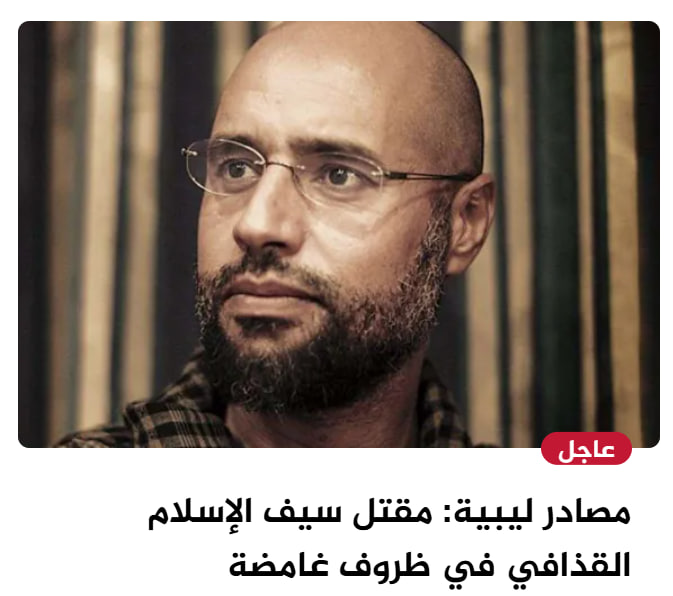
Libya’s already volatile political landscape has been further destabilized by unconfirmed but widely reported accounts of the assassination of Saif al-Islam Gaddafi, son of the late leader Muammar Gaddafi. Reports suggest he was killed in an armed attack in Zintan, western Libya, an incident shrouded in conflicting narratives, political accusations, and official silence from state institutions.
Al Jazeera initially reported Saif al-Islam’s death in a mysterious shooting last Tuesday in Zintan, a city southwest of the capital, Tripoli. While details surrounding the event remain profoundly unclear, his political advisor, Abdullah Othman, reportedly confirmed the death on his official account, sparking widespread speculation across the fractured nation.
### Assassination Allegations and Shifting Blame
The precise nature of the shooting that led to Saif al-Islam’s demise is yet to be fully established. Al Jazeera correspondents in Tripoli detailed an assault by four armed individuals on his Zintan residence, who allegedly fired upon him collectively. This initial attack reportedly escalated into an armed confrontation between the assailants and other armed personnel present in the vicinity.
Further reports hinted at injuries sustained by members of the “Abu Bakr al-Siddiq Battalion,” a group notable for arresting Saif al-Islam in 2011 before his later release under a general amnesty law. His body was reportedly transferred from Zintan to Al-Rajban hospital. Intriguingly, Saif al-Islam was said to be residing in an area populated by fighters from this very battalion, ostensibly for his security. Some Libyan media outlets also claimed surveillance cameras at the site were deactivated prior to the killing, adding another layer to the mystery.
Allegations of responsibility quickly surfaced. Supporters of the former regime pointed fingers at “elite units” supposedly affiliated with Saddam Khalifa Haftar, accusing them of carrying out the assassination and engaging in clashes with Gaddafi’s guards – claims reported by Al Jazeera.
### A Figure of Enduring Contention
Saif al-Islam’s presence in Zintan and the wider southwestern Libyan desert had long been a source of political tension. Despite his previous detention by the Abu Bakr al-Siddiq Battalion, sources indicate he had cultivated stronger ties with his former captors, even establishing kinship with some, and traveled freely, including to Sabha in the south. However, just ten days before his reported death, Zintan saw fresh disputes between his supporters and those aligned with the 2011 revolution, who demanded either his handover to the International Criminal Court (ICC) or his permanent departure from the city.
Adding to the muddled narrative, news of clashes involving the 444th Brigade, a unit affiliated with the Tripoli government, in the Al-Hamada desert had circulated, though the brigade swiftly denied any role in Saif al-Islam’s killing or pursuit. Al Jazeera’s Libya correspondent, Suhaib Mahmoud, emphasized the persistent ambiguity surrounding the death of this controversial figure, who maintained a low-profile but enigmatic presence for years after his release from prison. He reportedly commanded a degree of military capability in the Al-Hamada desert, lacked a fixed residence, and constantly feared re-arrest or aerial attacks.
### From Heir Apparent to Post-Revolutionary Enigma
Born in 1972, Saif al-Islam was the second son of Muammar Gaddafi and once widely regarded as his father’s potential successor. After graduating in engineering and pursuing European studies, he rose to prominence from 2000, playing significant, albeit unofficial, roles in Libya’s domestic and foreign policy, notably leading sensitive negotiations.
In 2006, he launched the “Libya Tomorrow” reform project, widely interpreted at the time as a bid to facilitate a dynastic transition of power. With the outbreak of the February 17, 2011 revolution, he became a staunch public defender of the Gaddafi regime, frequently appearing on Libyan television to criticize revolutionaries as “foreign agents” and “traitors.”
His political journey took a dramatic turn with his arrest on November 19, 2011. Imprisoned in Zintan, the ICC sought his extradition for trial on charges of war crimes and crimes against humanity, a request Libya ultimately refused. Libyan courts proceeded with their own trials for corruption and war crimes, culminating in a Tripoli Court of Appeal verdict on July 28, 2015, sentencing him and eight other Gaddafi-era figures to death by firing squad in absentia.
However, his lawyer, Karim Khan, announced in July 2016 that Saif al-Islam had been released that April under a general amnesty law, after five years in prison, and remained in Libya. In a surprising re-emergence, he announced his candidacy for the presidential elections on November 18, 2021, making a heavily guarded appearance in Sabha. His political advisor confirmed that Libya’s Prosecutor General has launched an investigation into the recent incident, asserting that Saif al-Islam possessed no armed forces nor harbored animosity in Zintan, further deepening the mystery surrounding his reported death and its potential political fallout.