Strait of Hormuz Stability Tied to Respect for Iranian Rights, UN Envoy States
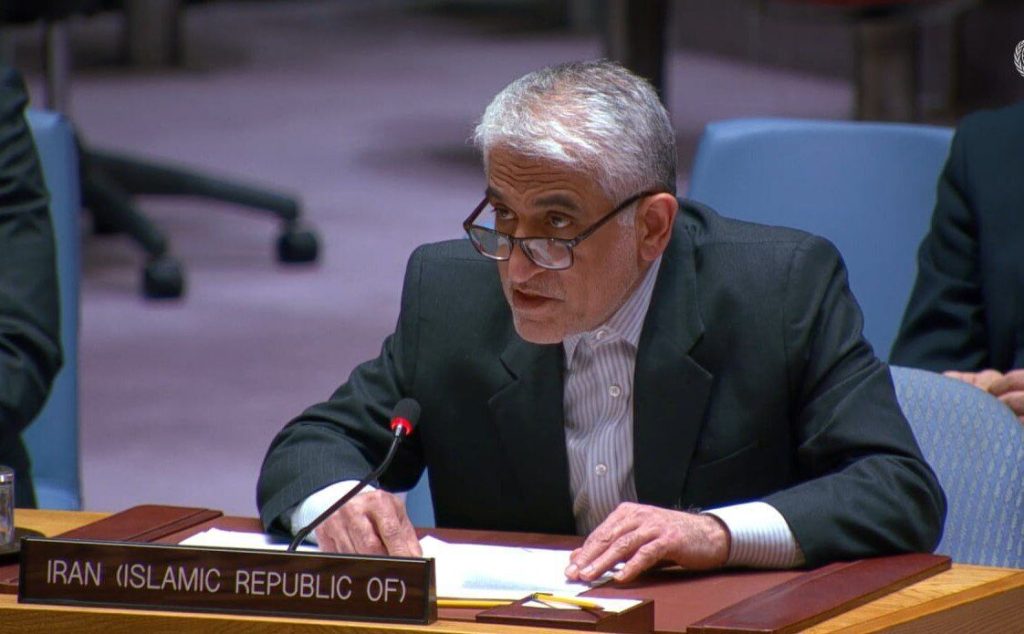
New York – Iran’s Ambassador to the United Nations, Amir Saeed Iravani, has asserted that enduring stability in the Strait of Hormuz and the broader region is achievable solely through the complete respect for Iran’s legitimate rights and interests. Speaking at a UN General Assembly session concerning a vetoed resolution on the Strait of Hormuz, Iravani underscored the critical importance of this principle for regional security and international maritime passage.
Veto of “One-Sided” Resolution Deemed Necessary
Ambassador Iravani highlighted that the timely and justified veto of a draft resolution by China and Russia was essential. He explained that the proposed text was one-sided, failing to acknowledge the root cause of regional tensions: the “illegal and brutal aggressive war by the United States and the Israeli regime against Iran on February 28, 2026.” The Iranian mission to the UN had previously emphasized that such a resolution could have established a dangerous precedent by undermining the sovereign rights of coastal states and potentially increasing the risk of escalation.
US Actions Undermine Regional Security
The Iranian diplomat pointed to recent unlawful actions by the United States, including attempts to impose a maritime blockade in the Strait of Hormuz, as evidence of the flawed logic underlying the vetoed draft. These actions, Iravani stated, have exacerbated tensions and pose a threat to maritime navigation and international trade security.
Iran’s Commitment to Maritime Safety
Iran, as a responsible state committed to the UN Charter and international law, has consistently upheld freedom of navigation and maritime safety in the Persian Gulf, the Strait of Hormuz, and the Sea of Oman, Ambassador Iravani affirmed. He emphasized that for decades, as a coastal state of the Strait of Hormuz, Iran has fulfilled its obligations in good faith, ensuring the security and freedom of maritime passage.
Precautionary Measures for Safe Passage
Iravani further elaborated that Iran has implemented necessary precautionary measures, guided by international law, to guarantee the safety and security of maritime traffic in the Strait of Hormuz. These measures are designed to facilitate continuous and secure passage for vessels and to prevent hostile or militarized exploitation of this vital waterway by aggressors and their affiliates.
US Blockade Deemed Gross Violation
The ambassador characterized the announced maritime blockade by the United States as a “gross violation of Iran’s sovereignty and territorial integrity.” He also described it as a clear breach of the prohibition against the threat or use of force enshrined in Article 2(4) of the UN Charter, constituting a manifest act of aggression under international law. Iravani stated that the United States must bear full responsibility for this internationally wrongful act and all its consequences, including its impact on regional and international peace and security.
Diplomatic Solutions Welcomed
Ambassador Iravani concluded by reiterating that achieving freedom of navigation and maritime safety in the Persian Gulf, the Sea of Oman, and particularly the Strait of Hormuz, which falls within the territorial waters of coastal states, is only possible through full respect for their sovereignty and sovereign rights. Iran, he added, welcomes and supports any credible diplomatic efforts and initiatives that can lead to a lasting cessation of the ongoing “illegal and baseless war.” This includes genuine endeavors by Pakistan, Turkey, Egypt, Saudi Arabia, as well as initiatives from China and Russia. Any viable solution, Iravani stressed, must guarantee a definitive and irreversible end to the aggression, establishing a just and lasting peace based on credible and verifiable guarantees of non-recurrence.