Title: Water Reserves in Iran’s Dams Fall to 52% Capacity, Prompting National Focus
A Critical Juncture for Water Security
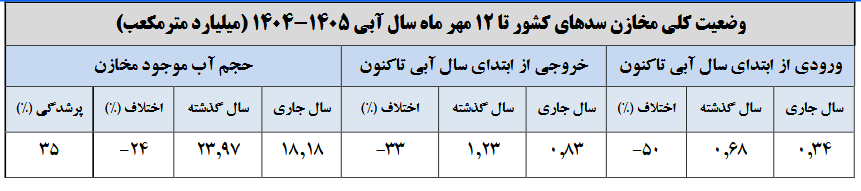
Recent data indicates a significant decline in Iran’s water reserves, with the total volume in the country’s dam reservoirs currently standing at 18.18 billion cubic meters. This figure represents a 24% decrease compared to the same period last year. The overall filling capacity of the nation’s dams has now reached 52%, highlighting a pressing challenge for national resource management.
Sharp Decline in Inflow and Outflow
The statistics reveal a concerning trend in water flow. Since the start of the current water year, the total inflow into the country’s reservoirs has been recorded at 0.34 billion cubic meters. This marks a 50% reduction compared to the 0.68 billion cubic meters recorded in the previous year. Concurrently, the total outflow from the dams has also seen a substantial decrease of 33% year-on-year, reflecting intensified conservation measures.
Key Dams at Critically Low Levels
The situation is particularly acute in several major dams across the country. Reports indicate that 24 dams are currently at less than 20% of their capacity. Notable among these are the Doosti and Torogh dams in Khorasan Razavi Province, the 15 Khordad Dam in the Qomroud basin, the Eteghad Dam in West Azerbaijan, and the Taham and Talvar dams in Zanjan Province. Dams in Fars, Kerman, and Markazi provinces are also facing similarly low water levels, underscoring the widespread nature of the issue.
Precipitation Levels Below Average
Compounding the reservoir situation is a deficit in rainfall. The total precipitation across the country has been measured at 1.5 millimeters to date. This is not only lower than the long-term average of 2 millimeters for the same period but also shows a significant drop from the 3 millimeters recorded in the previous water year. This climatic pattern presents a continuous challenge for water resource replenishment.
This data collectively points to a critical phase for Iran’s water management infrastructure, placing a strong emphasis on the need for strategic planning and sustainable resource allocation to ensure long-term water security.