Rewritten Title: A Turning Point in Tehran: The Match That Changed Persepolis’s Home Forever
In the annals of Iranian football, certain dates are etched not just for the sport, but for their broader societal impact. One such day was Tuesday, October 9, 1984, a day that would permanently alter the relationship between a legendary football club and its historic home ground.
The Spark of Unrest
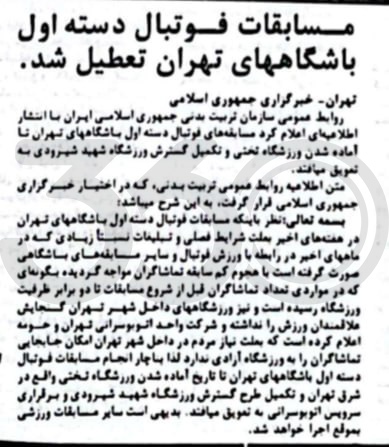
The stage was set for a highly anticipated Tehran Clubs League match between arch-rivals Persepolis and Pas at the Shahid Shiroudi Stadium. The immense public interest in the fixture led to a massive turnout, with some reports suggesting the crowd was double the stadium’s official capacity. Faced with an overwhelming and unmanageable situation, the Tehran Football Association made a fateful decision. An announcement over the stadium’s loudspeakers declared the match cancelled and postponed to the following Friday at the larger Azadi Stadium, where it would be held without ticket sales.
From Disappointment to Disorder
The announcement of the cancellation was the catalyst for a significant shift in the crowd’s mood. Initial disappointment and chants directed at the football officials soon evolved. The protests took on a more serious tone as the situation escalated from a sporting grievance into a wider public disturbance. Fans broke through fences, stormed the pitch, and proceeded to vandalize the stadium infrastructure. The chaos spilled out into the surrounding streets, necessitating the intervention of law enforcement, who made several arrests to restore public order.
The Political and Administrative Fallout
The consequences of that day’s events were immediate and far-reaching, prompting decisive administrative action.
- Suspension of the League: In a significant move, the Tehran Football Association indefinitely suspended the entire Tehran Clubs League. The official reasoning cited the unprecedented turnout of fans, the inadequate capacity of city stadiums, and the inability of public transportation to handle such large crowds, underscoring the infrastructural challenges of the time.
- Official Accountability: The head of the Tehran Football Association, Mohammad Jan-Fada, was required to report to the judicial authorities in connection with the decision-making surrounding the match. He was subsequently released on bail, highlighting the formal scrutiny applied to the event.
A Permanent Farewell
The most enduring legacy of that October day was its effect on the Persepolis football club. In the wake of the disturbances, the decision was made to relocate the team’s home matches. Except for a single match in 2001, Persepolis never again played a league game at the Shahid Shiroudi Stadium, marking a definitive end to an era and forcing the club to establish new homes elsewhere in Tehran. The incident stands as a pivotal moment where the passion for football intersected with public sentiment, leading to a permanent change in the sporting landscape.