Beyond Power: The Enduring Political Resonance of Imam Khomeini’s Household in Iran
As the Islamic Revolution approaches its 47th anniversary, the role and enduring significance of Imam Khomeini’s household have once again become a focal point, drawing attention from international media such as Al Jazeera. While the family no longer serves as a direct center of political decision-making, its name continues to operate as a potent source of “symbolic capital” within Iran’s political landscape, actively shaping discourse in a nuanced middle ground.
The Symbolic Capital of a Founder
In a political system that does not operate on explicit hereditary succession, certain names evolve over time into invaluable symbolic assets. Imam Khomeini, the founder of the Islamic Republic, stands as the clearest example. His image and revolutionary discourse remain integral to the state’s legitimacy, even as they fuel ongoing debates about the very definition of the revolution and the true meaning of “Imam’s Line.” As each anniversary of the revolution arrives, these symbols resurface, not as relics of the past, but as dynamic tools in contemporary struggles over legitimacy and narrative within the nation.
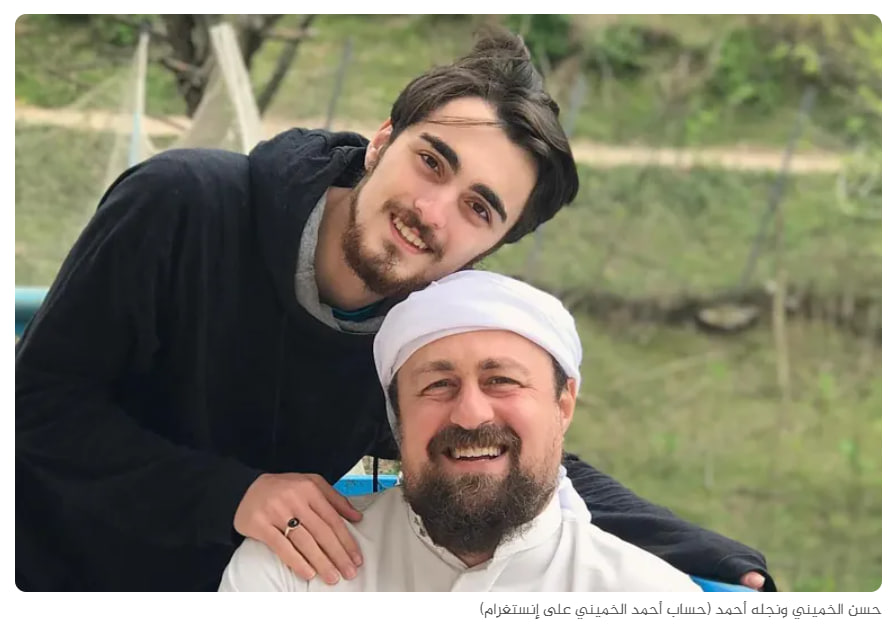
Today, while the Khomeini family is not at the helm of day-to-day governance, it retains an active presence in the realm of symbolism and legitimacy. Led by Imam Khomeini’s grandson, Hassan Khomeini, and supported by a younger generation – including his son, Ahmad Khomeini – who are more engaged with politics and media, the household represents a unique political phenomenon. Observers, both critics and allies, often view its role not as a project for familial rule, but rather as a barometer reflecting the internal balances and shifts within the broader political system.
Guardians of the Legacy: Key Figures of the Khomeini Household
The Khomeini household presents a diverse array of public figures, each interpreting and influencing the revolutionary legacy in distinct ways.
Hassan Khomeini: The Political Face of a Timeless Legacy
As Imam Khomeini’s most prominent grandson in the public sphere, Hassan Khomeini’s influence stems not from an executive position, but from intertwined sources of power:
- Historical-Religious Symbolism: His direct lineage as the founder’s grandson grants him inherent symbolic authority.
- Presence in Sacred Spaces: His frequent appearances at locations tied to Imam Khomeini’s memory, such as his mausoleum and the historic Jamaran Husseiniyah – where the Imam delivered many of his revolutionary speeches – transform these sites into platforms for political messaging.
Hassan Khomeini’s political language is notably characterized by a discourse often aligned with concepts of “moderation” and “reform.” He advocates for internal cohesion, emphasizes “the voice of the people,” and warns against a deepening divide between the state and society. This unique positioning has made him a symbolic reference point, or at least a nexus, for a broad spectrum of reformists and moderates. He is seen not as a party leader, but as a figure through whom the idea of “returning to Imam’s Line” can be reasserted against extremism or stagnation. However, a critical question remains: to what extent do the real centers of power – the oversight bodies, security apparatus, and what is termed the deep state – permit this symbolic influence to translate into institutional power?
Ahmad Khomeini: A New Generation’s Perspective
Ahmad Khomeini represents the “third generation” of the family. Less bound by the protocol restrictions of senior clerics, he is more attuned to media spaces and contemporary political debates. For reformists, Ahmad’s presence offers two key advantages:
- Generational Continuity: He ensures the continued relevance of the “Khomeini household” for a younger generation who encounter the revolution more as historical study than lived experience.
- Relative Boldness: He demonstrates a capacity for expressing critical views on performance, albeit within the system’s framework.
Ahmad Khomeini is a known supporter of former President Mohammad Khatami, a prominent reformist figure, and also backed Green Movement leaders following the 2009 elections. His engagement extends to art, cinema, and sports events, where he supports youth initiatives alongside his religious studies. Conversely, conservatives view the emerging figures of the Khomeini household as an effort to reproduce legitimacy for a specific political faction. They distinguish between accepting the family’s symbolic status and cautioning against its transformation into an organized political force.
Ali Khomeini: The Revolutionary-Security Imperative
Another of Imam Khomeini’s grandsons, Ali Khomeini, aligns his rhetoric more closely with conservative institutions and the demands of revolutionary security. In Iranian media, he is sometimes perceived as articulating the “hardline” narrative of the revolution, prioritizing the system’s survival and justifying security firmness as a fundamental logic of the revolutionary state.
His explicit defense in 2016 of the extensive executions of the 1980s as “necessary” for the preservation of the Islamic Republic garnered significant attention, sparking widespread legal and political debate. This incident highlighted how the name of Khomeini can inform two seemingly divergent interpretations of the revolution: one emphasizing republicanism and internal dialogue, and another prioritizing deterrence and the removal of opposition.
Other Members
Alongside Hassan, Ahmad, and Ali, other family members such as Zahra Mostafavi (Imam Khomeini’s daughter) and Yaser Khomeini also appear in the public domain, though typically not in frontline political roles.
The Political Stakes: Interpreting the Legacy
Reformists and the Khomeini Household
Since the rise of reformists in 1997, they have consistently sought a legitimate umbrella within the system. The name of Khomeini serves as an indispensable reference point, one from which it is difficult to detach the revolutionary attribute. Jamaran Husseiniyah, in particular, has become a symbolic venue for reformist presence during critical events. The reformist rationale is clear: if conservatives accuse rivals of straying from the revolution’s path, the counter-argument is that reformists adhere more closely to the founder’s original text.
Conservative Reservations
Conservatives frame the debate not around respect for Khomeini’s legacy, but around the exclusive interpretation of it. Their primary concern is preventing a “national symbol” from becoming a “political pole” or a direct rival.
Symbolic Power vs. Institutional Authority
A notable example illustrating the limits of this symbolic power was Hassan Khomeini’s disqualification from the 2016 Assembly of Experts elections. This event demonstrated that even the name of Khomeini does not confer automatic immunity from the decisions of oversight bodies, underscoring the distinction between symbolic influence and institutional power.
The Soft Power of Legacy
The influence of the Khomeini household today is measured not by the number of political seats it holds, but by its capacity to shape the “vocabulary of the revolution” through institutions like the Institute for Compilation and Publication of Imam Khomeini’s Works and by managing narratives.
The “After the Leader” Question
Whenever discussions regarding future leadership arise, Hassan Khomeini’s name is occasionally put forth as a symbolic option. He is considered not as a definitive candidate, but as an indicator for assessing the direction of potential developments. However, any final decision remains subject to the complex interplay of institutional balances and power networks, with heightened sensitivity surrounding any perception of hereditary succession.
Why the Heightened Focus Now?
The current period sees an increased sensitivity to these dynamics for two main reasons:
- The divide between the government and society has deepened.
- The political conflict has shifted from daily policy disputes to a more fundamental struggle over the narrative and definition of the revolution itself.
The Household as an Institution of Symbolism, Not Governance
Ultimately, what remains of “Imam Khomeini’s Household” is a power of symbolism rather than a power of decision-making. The family navigates a delicate space: leveraging the founder’s name to advocate for “reform from within the revolution” against conservative institutions that are wary of the name becoming an institutional rival.
In Iran, while “Imam Khomeini’s Household” may not directly govern, it retains the ability to disrupt public discourse through its statements and attract attention through its silence. This exemplifies the function of symbols in systems where legitimacy carries paramount importance: a presence sufficient to construct meaning, yet constrained enough to avoid making direct policy decisions.