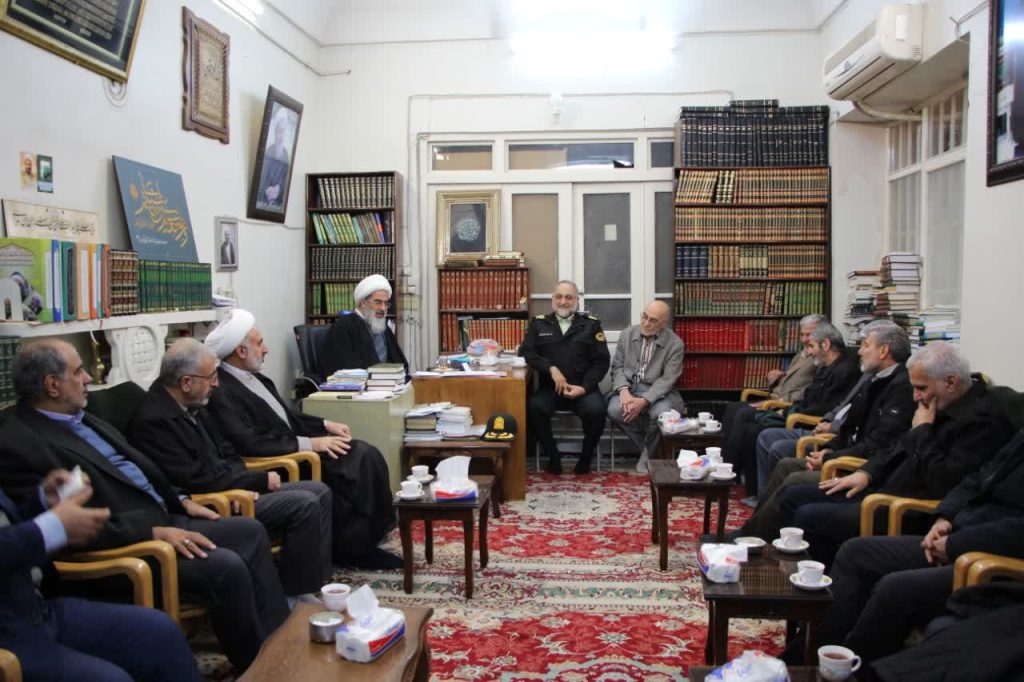
Iran’s Police: Guardians of Faith and National Honor, Says Prominent Cleric
Qom, Iran – In a significant meeting with senior police officials from Qom province, prominent cleric Ayatollah Mohammad-Javad Fazel Lankarani underscored the multifaceted role of Iran’s police force, asserting that their duties extend far beyond maintaining physical security to safeguarding the nation’s religious integrity and national honor.
The Ayatollah, a member of the Society of Seminary Teachers of Qom, emphasized that a stronger police force directly correlates with enhanced national credibility and the robustness of the Islamic system.
Defending Faith and National Integrity
Ayatollah Lankarani articulated a profound vision of the police’s mission, likening their responsibilities to the protection of divine ‘trusts’ (Amānat) bestowed upon the people. Citing a Quranic verse, he explained that life, property, human dignity, faith, and the very Islamic Revolution itself are all sacred trusts. Therefore, the police’s efforts in defending public security are inherently tied to preserving religious values and the nation’s reputation. He stressed that the Islamic Revolution, founded on the teachings of God’s religion, represents a monumental divine trust, which police are instrumental in upholding.
Confronting Recent Unrest and External Plots
Commending the police for their decisive role in confronting recent domestic unrest, Ayatollah Lankarani praised their prominent presence and sacrifices, including the martyrdom of personnel. He characterized these incidents as a “new sedition” orchestrated by enemies, describing their tactics as “savage and worse than ISIS,” aimed at portraying Iranian youth as abandoning religious and human values.
However, he noted that the “awakened people” of Iran, through their magnificent rallies, such as the one on January 12th (22 Dey), successfully thwarted these hostile plots. He urged officials, including military, police, seminaries, and academic centers, to conduct thorough research into the root causes of such vulnerabilities among youth, suggesting external “think tanks” exploit scientific methods to corrupt minds.
The Cyberspace Challenge
Highlighting a critical national security concern, Ayatollah Lankarani pointed to the uncontrolled nature of cyberspace as a significant source of harm. He contended that if internet access had been restricted earlier during the unrest, many incidents could have been prevented. He criticized responsible officials for their perceived inaction despite the Supreme Leader’s repeated emphasis on managing cyberspace, which he stated is now eroding family foundations, social cohesion, and humanity itself. While acknowledging its economic benefits, the Ayatollah called for comprehensive solutions to mitigate its dangers while addressing the needs of those who rely on it for their livelihoods.
Strengthening the Security Apparatus
The cleric affirmed that the police’s distinguished performance and sacrifices during the recent unrest have elevated public perception and their overall credibility. He called for substantial improvements in the police force, advocating for quantitative and qualitative enhancements and increased resources to ensure a stronger, more effective presence.
Martyrdom and National Resilience
Ayatollah Lankarani lauded the unwavering spirit of the Iranian people, exemplified by the families of martyrs, such as the mother of Shahid Asadi, who expressed readiness to sacrifice all her children for Islam. He asserted that such profound dedication, nurtured by the teachings of Imam Khomeini and the Supreme Leader, demonstrates the nation’s enduring commitment to its principles.
He further stated that despite facing immense pressures from “cruel sanctions, mismanagement, and the treacherous actions of corrupt individuals,” the Iranian nation has steadfastly supported the Islamic Revolution and its leadership, disproving enemy propaganda about a disconnect between the people and their system.
Towards a Greater Divine Vision
Concluding his address, the Ayatollah referenced a powerful Quranic verse (8:39), which mandates fighting “until there is no [more] fitnah and [until] worship is [acknowledged to be] for Allah alone.” He explained that this divine command seeks to eliminate polytheism and disbelief, culminating in the complete establishment of monotheism.
He linked the sacrifices of all martyrs throughout Islamic history – from the companions of the Prophet to those of the Revolution and recent security incidents – to this overarching divine objective, seeing them as integral steps towards the eventual global government of Imam Mahdi (AJ). He stressed that every action in service of Islam and the Revolution contributes to this divine promise, while those who commit corruption, despite outward appearances, align themselves with disbelief and evil.