Title: A New Era for Marital Contracts: Iran’s Evolving Legal Framework for Financial Security
In a significant shift within Iran’s family law system, recent legal reforms are redefining the concept of financial security for married women, moving beyond the traditional reliance on the Mehrieh (dowry) towards a more comprehensive and sustainable model of contractual rights.
The Evolution of Mehrieh: From Penalty to Fair Compensation
According to Mr. Akbar Monfared, a prominent lawyer and university professor, the legal philosophy surrounding the Mehrieh—a financial gift from the husband to the wife mandated at marriage—is undergoing a fundamental transformation. While the Mehrieh remains a right fully belonging to the woman under Islamic law, its enforcement has been modernized.
Key changes, effective since 2023, have refined the enforcement of financial obligations. Imprisonment for non-payment has not been eliminated but is now more restricted. A husband can only be detained if he possesses the financial means but refuses to pay up to a threshold of 110 gold coins. If a court establishes his financial incapacity, imprisonment is no longer an option. Instead, the law mandates a fair, long-term payment plan based on his ability to pay.
“The philosophy of the law has shifted from punishing the debtor towards ensuring fair financial compensation,” Monfared stated.
Systemic Reforms: Curbing Abuse and Ensuring Transparency
Further reforms have been implemented to create a more robust and transparent system. For claims exceeding 110 gold coins, payment is now contingent upon the wife providing proof of the husband’s substantial assets. Furthermore, to prevent nominal or fictitious Mehrieh amounts, all dowries must be officially and electronically registered in the national marriage registration system (Siah).
A major development in 2024 was the launch of the Secured Marriage Assets System (Seda) by the National Registration and Central Bank organizations. This system allows for non-cash Mehrieh, such as bank deposits, stocks, life insurance, or property, whose value is registered and trackable from the date of the marriage contract.
A New Paradigm: Contractual Rights as the Cornerstone of Security
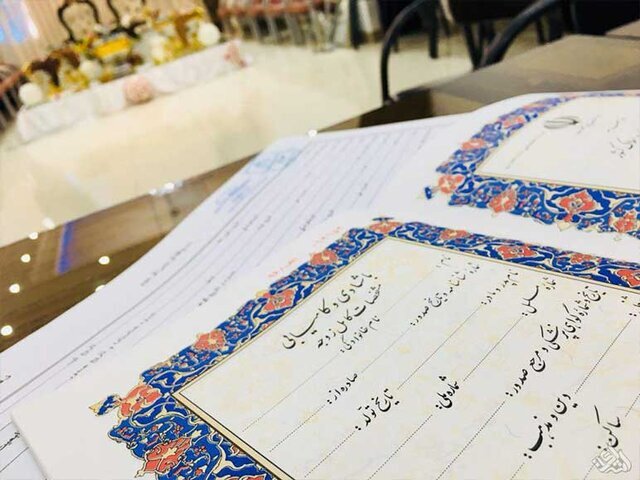
The most profound change, however, lies in the proactive promotion of contractual rights within the marriage agreement. Since 2024, marriage registration offices are legally required to formally present couples with four key rights to be included in their contract:
- Power of attorney for the wife to initiate divorce proceedings.
- The right to determine the place of residence and to travel abroad.
- The right to employment without requiring subsequent permission from the husband.
- The right to half of the assets acquired during the marriage in case of a divorce initiated by the husband.
“This change demonstrates that the Mehrieh is no longer the sole tool for a woman’s financial support. It is being replaced by a combination of contractual rights,” Monfared explained.
He also highlighted other pivotal contractual conditions gaining prominence, such as the right for the first wife to grant permission for a second marriage, which significantly contributes to marital stability.
Fostering Informed Partnerships
Underpinning these legal shifts is a new emphasis on education. As of March 2024, attending pre-marriage family law courses has become mandatory for the official registration of a marriage. This ensures couples are fully aware of the implications of the Mehrieh, their contractual options, and the legal consequences of marriage.
A Forward-Looking Policy
In analysis, these 2024 reforms represent a foundational change in the philosophy of marital financial security. The approach is moving away from a heavy financial guarantee towards fostering conscious, fair, and realistic contracts that create symmetrical rights and responsibilities between spouses.
“The goal of these policies is to reduce the population imprisoned for dowry debt, decrease divorce litigation, and provide women with independence and financial security through more sustainable legal tools,” Monfared concluded. “Informed women today are opting for reasonable Mehrieh and, in return, registering effective and enduring rights in their marriage contracts—an approach that creates genuine legal security and will lead to a significant reduction in family disputes.”