Bitcoin Navigates Uncertainty: A Political Lens on Market Volatility
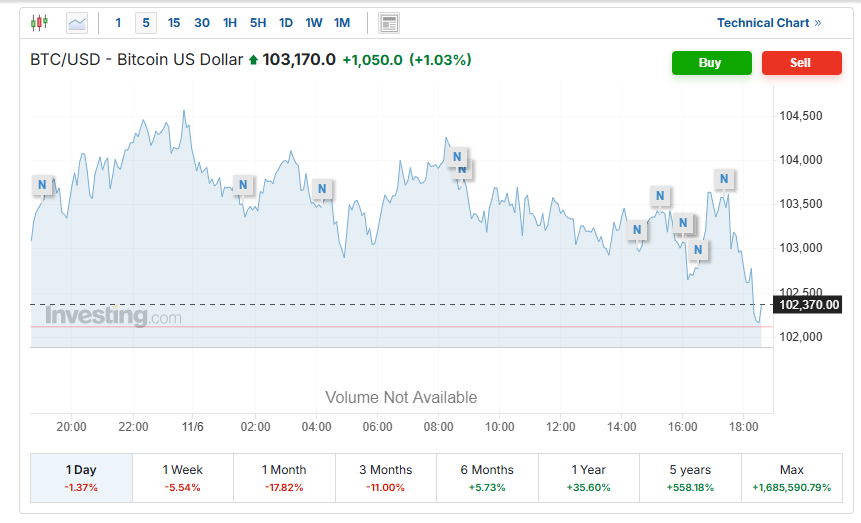
The cryptocurrency market finds itself in a cautious holding pattern, with Bitcoin experiencing significant volatility near the $103,000 mark. A prevailing climate of “Fear,” as measured by market sentiment indices, is being fueled by a complex interplay of economic policies and shifting institutional investment trends.
Market Sentiment and Key Drivers
The overarching mood among traders remains cautious. This sentiment is largely attributed to a decline in global liquidity inflows and substantial capital withdrawals from major cryptocurrency Exchange-Traded Funds (ETFs). Analysts point to underlying concerns about the future trajectory of the U.S. economy as a primary factor reinforcing this risk-averse environment. The performance of the U.S. dollar index continues to be a critical barometer, with its strength applying temporary corrective pressure on the crypto market.
Bitcoin’s Precarious Position
Bitcoin, the market bellwether, has been on a rollercoaster. After reaching a daily high of $104,265, selling pressure pushed it down to test the crucial $102,000 support level. Technical analysts identify this zone as a key short-term battleground. A sustained break below could open the path toward $100,000, while a decisive push above the resistance of $104,800-$105,500 is needed to activate a fresh bullish momentum toward $107,000.
The market’s structure is further highlighted by a significant liquidation of over $300 million in leveraged positions in 24 hours and a rise in Put Options at the $80,000 strike price, indicating traders are bracing for potential volatility.
Institutional Flows and Political Endorsements
Data from the previous session reveals a notable shift in institutional behavior:
- Bitcoin ETFs: Witnessed an outflow of $137 million.
- Ethereum ETFs: Saw $118.5 million exit.
- Solana ETFs: Were a rare bright spot with a modest $9.7 million inflow.
These figures suggest a cooling of institutional demand. However, this trend exists alongside notable political developments. Former U.S. President Donald Trump recently reiterated his support for digital assets, stating that cryptocurrencies “reduce pressure on the dollar and bring good results.” Market observers interpret such comments as a sign of a gradual policy shift toward the formal acceptance of cryptocurrencies within the U.S. economic framework.
Altcoin Performance and Broader Economic Context
The market’s caution was reflected in the mixed and largely subdued performance of major alternative cryptocurrencies (altcoins). While Ripple (XRP) and Solana (SOL) posted modest gains, others like Binance Coin (BNB), Dogecoin (DOGE), and Cardano (ADA) experienced declines. This fragmented performance underscores a lack of unified market direction.
Broader economic headwinds are also in focus. A recent report on U.S. job cuts, showing the highest levels in decades, has sounded a fresh alarm for the labor market. Such data influences the policy decisions of the Federal Reserve, which in turn impacts global liquidity and risk appetite, including for crypto assets.
Technical Outlook and Path Forward
In the short term, analysts predict Bitcoin will likely continue to oscillate between $100,000 and $106,000. The market is currently in a state of “wait-and-see,” requiring a fresh injection of liquidity or positive global economic data to catalyze the next significant bullish wave. A clear break above $106,500 is identified as a potential trigger for a new upward trend, while a fall below $99,000 could invite intensified selling pressure. For now, the political and economic landscape continues to dictate the pace, leaving the crypto market in a period of watchful anticipation.