Iran’s Silent Maritime Strategy: Miniature Submarines Reshape Hormuz Dynamics
Hormuz’s Strategic Waters
The Strait of Hormuz, a critical choke point for global energy shipments, is a focal point for international maritime security. According to a report by the Daily Telegraph, Iran’s naval capabilities in this vital waterway, particularly its reliance on small submarines, naval mines, and shore-to-sea missiles, represent a significant strategic factor. Military analysts suggest these capabilities could pose challenges to one of the world’s most critical energy pathways in the event of a conflict, proving difficult to counter even for the most advanced naval forces.
The report notes past instances of low-altitude flights by US A-10 attack jets over the Strait, targeting Iranian fast boats, with Apache helicopters reportedly joining operations that involved 5,000-pound bombs striking underground weapon positions in southern Iran. These actions, as stated by the US, aimed to neutralize maritime threats and ensure the security of vital shipping lanes, contributing to global energy stability.
The Covert Advantage: Miniature Submarines
However, analysts highlighted that the primary focus of concern for shipping may lie with assets beyond the reach of aerial surveillance: Iran’s fleet of miniature submarines, specifically designed for the shallow, often murky waters of the Persian Gulf.
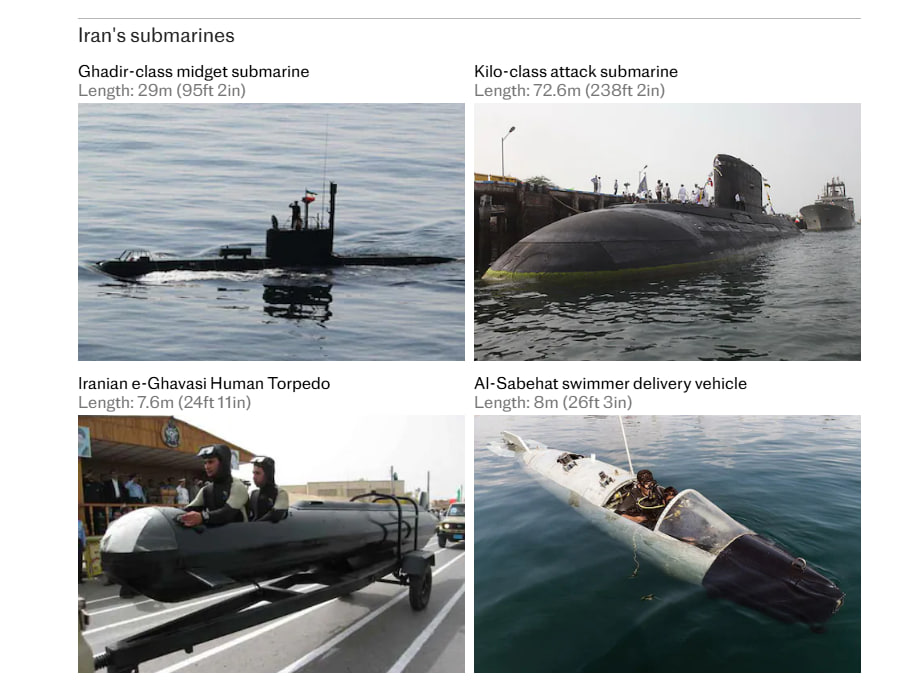
Iran possesses up to ten Ghadir-class submarines, which are approximately one-tenth the size of conventional attack submarines, weighing around 120 tons and measuring 29 meters in length. Their compact size allows them to operate effectively at depths of around 30 meters—the average depth of the main shipping channels in the Strait of Hormuz—potentially without detection.
The challenging environmental conditions of the Strait, characterized by shallow waters and significant background noise from shipping and drilling activities, complicate efforts to detect and neutralize these smaller submarines.
Ghadir Class: Tailored for the Gulf
Beyond their stealth capabilities, Ghadir-class submarines can deploy Hoot torpedoes, which, according to Iranian sources, employ supercavitating technology to achieve speeds of up to 220 miles per hour underwater. Crucially, military analysts suggest a single Ghadir-class submarine could covertly lay dozens of mines in shipping lanes under the cover of night. For over four decades, Iran has diligently studied the precise conditions of the Persian Gulf and exclusively trained its submarine forces for operations within these specific waters. Experts indicate that Tehran could leverage the unique geography of the Strait of Hormuz and its specialized submarines to influence global economic dynamics and constrain shipping routes.
A Diverse Naval Arsenal
Miniature submarines are just one component of Iran’s multifaceted naval strategy.
Submarine Fleet Expansion
Iran’s naval assets also include special “Al-Ghawasi” and “Al-Sabahat” vessels designed to transport combat divers, facilitating special operations and clandestine mine-laying in shallow coastal waters. These craft can also be fitted with explosive warheads for use as unmanned explosive boats.
Larger Fateh-class submarines, weighing around 600 tons, feature more advanced sensors and torpedoes, enabling operations in deeper waters while remaining agile enough for near-coast activities. Older models include the small Nahang-class submarines and three Kilo-class diesel-electric submarines—Tareq, Younis, and Nooh—acquired from Russia in the 1990s. While these Kilo-class submarines weigh approximately 3,000 tons, their utility in the shallow northern Persian Gulf is somewhat limited. The semi-heavy Besat submarine represents Iran’s newest design, though specific production details remain limited.
All these submarine platforms are capable of carrying torpedoes and naval mines. Analysts emphasize that Iran’s primary strategic objective may not necessarily be to engage and sink large naval vessels, but rather to disrupt shipping lanes through covert mine-laying—an operation that could potentially take weeks to clear.
Fast Attack Craft and Special Operations
The Islamic Revolutionary Guard Corps Navy operates hundreds of fast attack craft, optimized for “swarm tactics” in confined maritime environments. The Zolfaghar-class boats, equipped with defensive systems, are considered among Iran’s most capable attack craft. The majority of the fleet, however, comprises smaller armed boats that can operate from numerous small ports and coastal inlets. The Bavar-2 is a ground-effect vehicle (WIG craft) that can skim above the water’s surface, offering enhanced speed and a reduced radar cross-section. Iran has also showcased remote-controlled explosive boats, which can be pre-positioned in coastal areas and activated when necessary. Despite reports of US airstrikes on some IRGC naval bases, these craft require only minimal launch facilities and can be concealed in civilian ports, making their complete neutralization challenging.
Coastal Defenses and Missile Deterrence
Mobile, truck-mounted anti-ship missiles represent a significant deterrent, as their mobility makes them difficult targets for aerial engagement. Iran possesses a range of these missiles:
- Kowsar: Approximately 12 to 15 miles range.
- Nasr-1: Up to 22 miles range.
- Ghader and Ghadir: Around 186 miles range.
- Noor (based on China’s C-802): Up to 106 miles range.
- Abu Mahdi: Reportedly extends up to 621 miles, capable of threatening targets far from Iran’s coast.
Iran has also developed anti-ship ballistic missiles such as the Khalij Fars and Hormuz-2, with ranges of approximately 186 miles, designed for satellite-guided targeting of moving vessels. These missile systems are typically mounted on trucks, concealed in mountain tunnels, stored in reinforced bunkers, and frequently relocated to enhance survivability. Furthermore, Iran has demonstrated the capability to launch Shahed suicide drones from submarines.
The Lingering Threat: Naval Mines
Despite the array of weaponry, military analysts suggest that Iran’s most impactful capability may not be torpedoes, but rather naval mines. Iran has accumulated a diverse inventory of naval mines over several decades, including:
- Contact mines
- Magnetic mines
- Acoustic mines
- Pressure mines
Some advanced models are reportedly capable of identifying specific vessel types, allowing them to selectively detonate for large oil tankers, for instance. Siddharth Kaushal, a research fellow at the Royal United Services Institute (RUSI), commented that while the primary challenge for Iran in mine-laying is positioning vessels in the Strait of Hormuz, its small Ghadir-class submarines effectively overcome this hurdle. He further noted that while surface mine-laying operations would be vulnerable to aerial assets like A-10s and Apache helicopters, small submarines do not share this vulnerability.
Conclusion: Strategic Implications in a Vital Strait
In essence, Iran’s strategic deployment of miniature submarines and a diverse range of naval assets, particularly their covert mine-laying capabilities, presents a complex dynamic in the Strait of Hormuz. This approach highlights a focus on asymmetric warfare designed to leverage the unique geography of the region to potentially influence global maritime trade and energy flows, underscoring the ongoing strategic importance of the Strait.