US Military Strains: Financial Times Reveals Critical Ammunition Depletion in Iran Conflict
Washington D.C. – A recent report from the Financial Times, citing informed sources, has cast a spotlight on the significant strain on the United States’ military resources. The report indicates that the U.S. has rapidly consumed critical ammunition stockpiles, accumulated over years, since initiating military operations characterized by the publication as a “war against Iran.”
Escalating Costs and Rapid Depletion
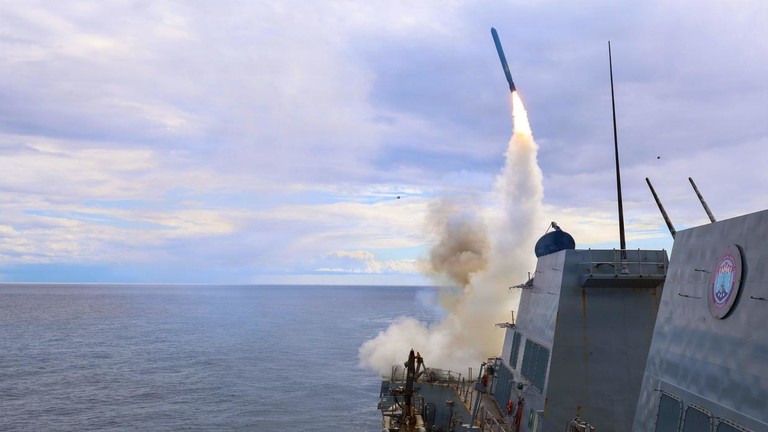
According to the Financial Times, Pentagon officials, in a private briefing earlier this week, estimated that the first six days of these U.S. operations against Iran alone incurred a cost of at least $11.3 billion. This rapid depletion of munitions has triggered considerable concern within Washington regarding the escalating financial burden of the conflict and the nation’s capacity to replenish key weapon systems, particularly advanced, long-range Tomahawk missiles.
The Center for Strategic and International Studies (CSIS) in Washington estimated that U.S. forces expended 168 Tomahawk cruise missiles within the initial 100 hours of operations against Iran. A source quoted by the Financial Times underscored the gravity of this expenditure, noting, “This is a huge cost for Tomahawk missiles. The Navy will feel this for several years.” The source further added that the U.S. is facing a deficit unlikely to be resolved in the near future.
Strained Strategic Reserves and Replenishment Challenges
Each Tomahawk cruise missile, a long-range, subsonic offensive weapon employed by the U.S. Navy and capable of carrying a 1,000-pound warhead, is valued at approximately $3.6 million. Compounding the issue, the U.S. military has procured a mere 322 of these missiles over the past five years. Even a planned acquisition of 57 missiles for fiscal year 2026, costing $206.6 million, would only suffice to partially replace those likely expended in recent operations.
Official Assurances Versus Operational Reality
The scale of U.S. expenditures reported by the Financial Times stands in stark contrast to recent public assurances from Washington officials. Earlier this month, Pete Hegseth, a prominent political figure, asserted that U.S. “ammunition stocks are full and our will is ironclad.” Similarly, former President Donald Trump boasted of the nation’s “almost unlimited” weapon reserves, claiming the ability to fight battles “forever.” The Financial Times report highlights a significant discrepancy between these public statements and the operational reality on the ground.
Mounting Congressional Opposition and Funding Hurdles
In light of the mounting costs, the Pentagon is anticipated to imminently submit a request to the White House and Congress for up to $50 billion in additional military funding. However, any supplemental funding for the operations concerning Iran is expected to encounter substantial opposition in both chambers of Congress. The Financial Times noted that Democratic lawmakers are particularly likely to react unfavorably, with many questioning the legality of the campaign given the absence of explicit Congressional authorization. The situation underscores a deepening internal political challenge for Washington as it navigates the costs and political ramifications of its ongoing military engagements.