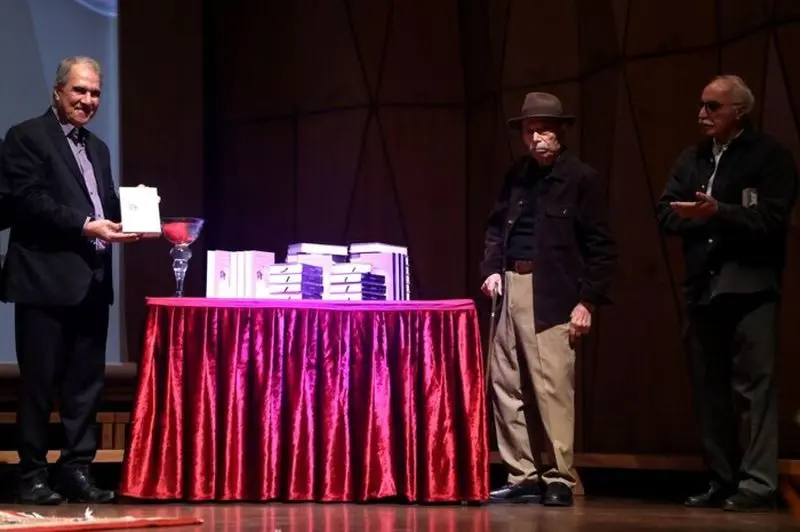
From Classroom Rebel to Cultural Luminary: A Tribute to Farhad Ayesh
A gathering of Iran’s artistic elite celebrated the career and recent publication of actor and playwright Farhad Ayesh, a figure whose journey from a self-described “troublemaker” in school to a revered artist highlights a profound dedication to his craft.
The event, held to mark the release of his book “Theatre Suitcase” by Ishka Publications, brought together prominent figures including Ali Nassirian, Darioush Mowdabian, Ebrahim Haghighat, Hassan Fathi, Maryam Saadat, and Hamid Naeemi, among many others.
An Unconventional Journey
The ceremony opened with a video montage of Ayesh reflecting on his life. He spoke of his early years, humorously admitting he was “the worst student in the class,” and credited his family, especially his mother, for their influence. His path took a dramatic turn during his studies in America, where he discovered theatre. “In school, I had a problem with lessons and homework,” Ayesh recalled. “But since I have no problem with life itself, and art is the essence of life, for the first time I became the best student at university.”
He expressed humble surprise at being honored with such an event, stating, “The funniest thing for me is that they are holding a tribute for me because I have never seen myself as grand. But I love love, and those who prepared tonight’s program have done so out of love.”
A Unique Artistic Voice
Director Hamid Naeemi, who collaborated with Ayesh on several plays, delivered a speech praising the artist’s multifaceted talent. He described Ayesh as a unique voice in Iranian theatre, noting that while he has directed less in the past decade, the publication of his plays would introduce a new generation to his thoughts and philosophies.
Naeemi emphasized the distinctiveness of Ayesh’s writing style, stating, “Farhad Ayesh writes in Persian but thinks globally. His perspective describes the state of a frightened humanity in today’s world and signifies the desperation of the global postmodern world.”
The Playwright’s Perspective
In further video segments, Ayesh elaborated on his motivations as a playwright, though he hesitates to claim the title. He cited two primary drivers: compelling subject matter and a revolutionary approach to form, inspired by his love for the poet Nima Yooshij.
“My plays do not have a story,” Ayesh explained. “In my first plays, I mostly addressed the issue of women and patriarchy. Then, living abroad and seeing the situation of Iranian immigrants greatly influenced me. It was as if there were people with a suitcase in hand, thrown into an unknown place. Gradually, this subject took on a philosophical dimension.”
He also shared his unconventional writing process, stating he does not draft or experiment but writes the entirety he holds in his mind directly onto paper.
A Pillar of Iranian Arts
Ali Zarei, the theatre producer and head of Ishka Publications, hailed Ayesh as a foundational figure. “Farhad Ayesh is not just a name; he is a history for the theatre, cinema, and television of Iran,” Zarei said. “He has given a new life to theatre with his vision.” He praised Ayesh for his relentless innovation and his consistent rejection of clichés, noting his role in introducing young new faces to the arts.
During the ceremony, Ayesh was presented with the first-ever Ishka Publications statuette.
A Veteran’s Praise
The event reached an emotional peak with a speech by the esteemed veteran actor Ali Nassirian, who was met with enthusiastic applause. “I am very happy such a ceremony is being held for Farhad Ayesh because he deserves it,” Nassirian stated. “He is a man of the stage and is skilled in acting, directing, production, and writing.”
Nassirian highlighted creativity and sincerity as the core virtues of an artist, attributes he finds abundantly in Ayesh. “Theatre and cinema are a lie,” Nassirian elaborated, “and the actor, with his sincerity, destroys that lie and makes the work believable for the audience. Farhad Ayesh has both this sincerity and seriousness in his work, which are virtues not everyone possesses.”
Reflecting on their long collaboration, which began in the United States, Nassirian expressed his enduring gratitude: “I will never forget the happiness and good fortune of him seeking me out, us meeting and working together… I am happy that in my life I met Farhad Ayesh and benefited from and enjoyed his creativity. I hope his presence graces Iranian theatre and cinema for many years to come.”
The ceremony concluded with the official unveiling of “Theatre Suitcase,” a collection of twelve of Ayesh’s performed plays, solidifying his legacy as a creative force who transformed a rebellious spirit into a celebrated artistic career.