Afghan Women’s Defiant Stand: Kabul Streets Become a Bastion Against ‘Gender Apartheid’ on International Women’s Day
While the international community marked International Women’s Day on March 8th with celebrations of achievements and pursuits of gender equality, a starkly different scene unfolded in Kabul. Here, against a backdrop of systemic repression, Afghan women bravely took to the streets, transforming them into a bastion of resistance and a powerful outcry against what they term “gender apartheid.”
Kabul’s Silent Defiance
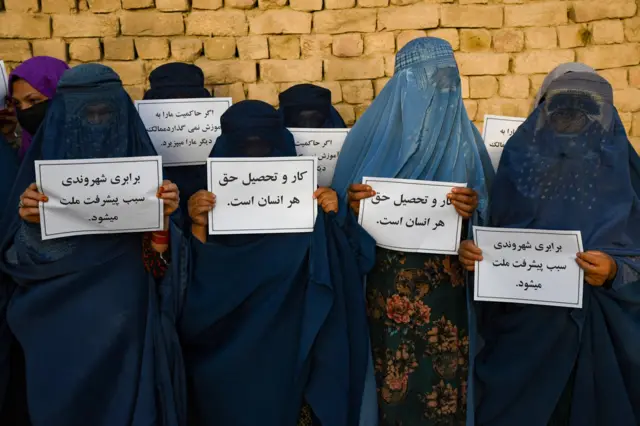
In a profoundly courageous act, a group of Afghan women, clad entirely in black and wearing masks to conceal their identities from Taliban surveillance cameras, gathered in the streets of Kabul. They held aloft a placard bearing the English phrase: “End Gender Apartheid.” This symbolic protest, undertaken despite profound threats to life, organized detentions, and brutal suppression over the past nearly five years, underscores the systematic marginalization of half of Afghanistan’s population. It is not merely a street protest but a resonant cry from women whose very existence has been re-defined as a global human rights crisis following extensive bans on education, employment, and social participation.
Understanding ‘Gender Apartheid’
The term “gender apartheid” refers to a system where women are systematically and institutionally deprived of fundamental human, social, economic, and political rights. Human rights experts increasingly apply this designation to the Taliban’s policies. Since their return to power in August 2021, the Taliban have progressively implemented sweeping restrictions, effectively erasing women from almost all facets of public life. This systematic process includes prohibitions on education, employment bans, severe restrictions on movement, and exclusion from political and social participation, impacting the lives of millions of Afghan women.
Systematic Erasure from Public Life
The Taliban’s policies have systematically dismantled the rights and opportunities of Afghan women across critical areas:
- Educational Exclusion: Initially, girls’ schools above the sixth grade were closed, followed by the closure of universities to women. This has deprived millions of Afghan girls and women of their right to education, fostering a “lost generation” and contributing to a sharp rise in illiteracy. Despite the extreme dangers, some courageous female teachers continue to operate underground schools.
- Economic Disempowerment: Women have been barred from working in most government and private sectors, including roles as teachers, doctors, nurses, civil servants, and even staff for international organizations. This ban has plunged millions of families, previously reliant on women’s incomes, into poverty, fostered economic dependency, and severely crippled Afghanistan’s workforce and economy.
- Mobility and Social Isolation: Women are mandated to be accompanied by a male guardian (mahram) for long-distance travel and are prohibited from entering parks, sports clubs, and many public spaces without one. The enforcement of a strict full-body covering (burqa) is compulsory, with non-compliance risking arbitrary arrest and harassment. These restrictions have increasingly confined women to their homes, severing their social connections and civic engagement.
Repression and Enduring Resistance
Any expression of dissent by Afghan women has been met with violent suppression by the Taliban. Numerous reports from human rights organizations detail arrests, torture, and abuse of women protesters. The Taliban seek to silence all voices of opposition through a climate of fear. Yet, despite these grave dangers, Afghan women continue to stage sporadic, high-risk protests, demonstrating an unwavering spirit of resistance.
International Condemnation and the Call for Action
The international community has largely condemned the Taliban’s policies. Richard Bennett, the UN Special Rapporteur on Afghanistan, has repeatedly denounced these policies as gender apartheid. The UN Human Rights Council has passed multiple resolutions on the matter, and numerous countries, including the United States and members of the European Union, have expressed strong condemnation. Organizations like Amnesty International and Human Rights Watch consistently document and raise global awareness of human rights violations against women in Afghanistan. However, the current response has largely consisted of diplomatic statements, with a notable absence of effective practical action to alter the dire situation.
Unwavering Resolve Amidst an Uncertain Future
On this International Women’s Day, Afghan women protested after nearly five years of systematic deprivation of their fundamental rights. The protest in Kabul, with its powerful “End Gender Apartheid” slogan, delivered a clear message to the world: Afghan women will not surrender. However, without sustained, coordinated, and effective international pressure, the Taliban are unlikely to alter their discriminatory policies. The future of Afghan women, and by extension the entire nation, hinges on concrete global action to end this pervasive system of gender apartheid.