Iran’s Automotive Market: A Snapshot of Key Domestic Models and Their Current Valuations
Tehran – The domestic automotive market continues to be a key sector of Iran’s economy, with several flagship models from major national manufacturers maintaining significant presence and consumer interest. A recent analysis provides a clear snapshot of the current pricing landscape for some of the most prominent vehicles.
Peugeot Models: Market Leaders
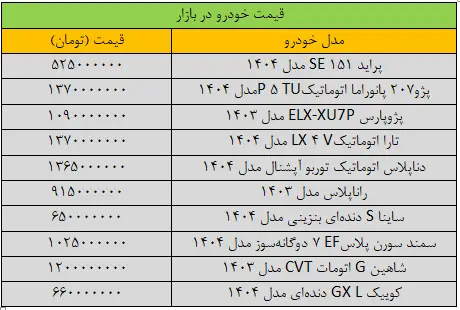
As a cornerstone of the domestic industry, Peugeot-branded vehicles demonstrate robust market activity. Key models include the 207 manual (TU5) at 1.02 billion tomans, the 207 Panorama manual at 1.1 billion tomans, and the 207 Panorama automatic (TU5P) at 1.37 billion tomans. The older 207 (TU3) model is valued at 905 million tomans. The Pars sedan series also shows stability, with the ELX-XU7P model from the previous year priced at 1.08 billion tomans.
Tara and Dena Plus: Modern Offerings
The Tara, a modern sedan, shows strong valuation with its V4 LX automatic model reaching 1.37 billion tomans. The Dena Plus, another advanced domestic model, sees its EF7 automatic turbo model trading at approximately 1.365 billion tomans, underscoring the market’s valuation of newer technologies and features.
Saina and Other Key Products
The Saina remains a popular choice in its segment, with the manual S model priced at 650 million tomans and its automatic version at 820 million tomans. The market also notes the presence of other significant models, such as the Reera automatic, valued at 1.9 billion tomans.
Samand, Quick, and Shahin: Established Names
The long-standing Samand Soren Plus model continues to hold its value, with prices ranging between 1.025 and 1.06 billion tomans depending on the fuel system. The Quick hatchback (GX L manual) remains an accessible option at 660 million tomans, while the Shahin automatic is noted at 1.3 billion tomans.
This pricing data offers valuable insights for consumers and underscores the dynamic nature of Iran’s strategic automotive industry, reflecting both consumer demand and the stability of domestic manufacturing.