Title: National Loan Backlog: A Closer Look at Bank Performance on Marriage and Childbirth Subsidies
Introduction: A Growing Queue for Support
Recent official data from the Central Bank of Iran has highlighted a significant gap between the number of applicants for state-supported loans and the number of citizens who have successfully received them. In the first six months of the current Iranian year, while substantial funds have been disbursed, hundreds of thousands of applicants for childbirth and marriage loans remain in a queue, awaiting approval and payment.
Childbirth Loans: High Demand Meets Logistical Hurdles
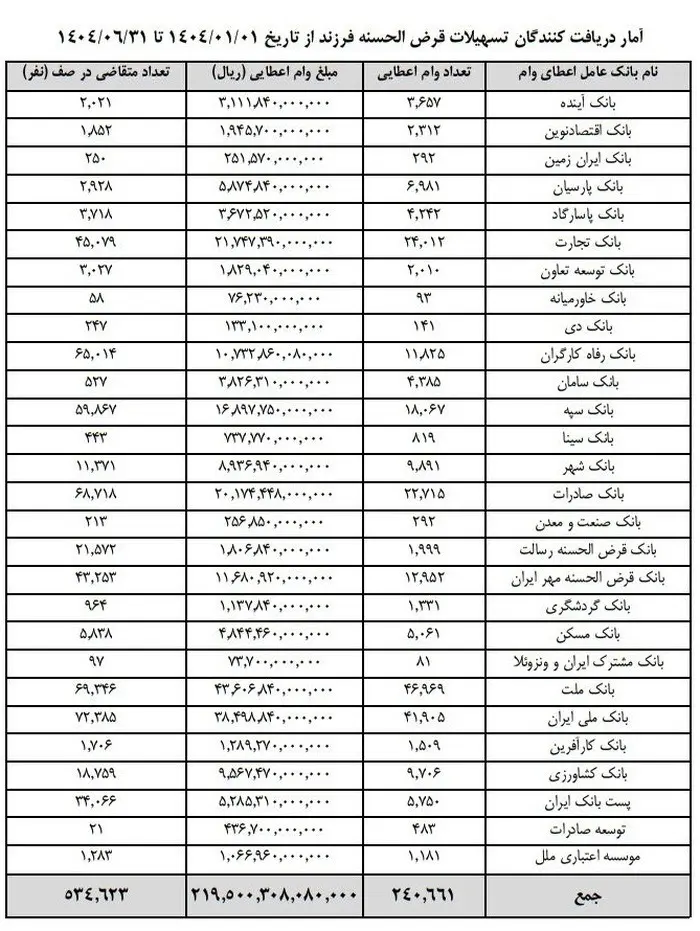
The figures for the “Childbirth Loan” reveal a pressing situation. By the end of the sixth month, facilities totaling 21,950 billion tomans were granted to 240,661 individuals. However, this has left a substantial waiting list of 534,623 applicants who have yet to receive their loans, underscoring the high public demand for this government support initiative.
- Key Institutions with the Longest Queues: Among the major banks, Bank Melli, with 72,385 pending applicants, has the longest queue for childbirth loans. It is closely followed by Bank Mellat (69,346) and Bank Saderat (68,718).
- Performance Disparities: A performance metric comparing the number of loans paid to the number of people in the queue reveals significant disparities. In this regard, Resalat Qard-al-Hasan Bank has the most challenging record, with a backlog of 21,572 individuals—approximately ten times the number of its successful loan recipients. Iran Post Bank and Bank Refah Kargaran also feature prominently on this list with significant backlogs.
Marriage Loans: A Similar Story of High Demand
The pattern for “Marriage Loans” mirrors that of the childbirth facilities. In the same six-month period, 97,811 billion tomans in marriage loans were distributed to 291,858 people. Nevertheless, a larger group of 541,215 applicants are still waiting to receive this financial support.
- Leading Banks by Backlog: The major banks also show the largest number of pending applications for marriage loans. Bank Melli leads with 102,715 applicants, followed by Bank Mellat (83,273) and Bank Saderat (72,339).
Spotlight on Underperformance
The data on marriage loans again places Resalat Qard-al-Hasan Bank at the forefront of institutions requiring performance review. This bank has approved loans for only 490 individuals, while 10,268 applicants remain in the queue—a ratio of 21 waiting applicants for every one recipient. Bank Keshavarzi holds the second position in terms of this challenging ratio, with a backlog roughly three times the number of its successful applicants.
The Path Forward: The Role of Regulatory Oversight
The accumulated data points to operational challenges within some banking institutions in fulfilling their mandated responsibilities. The significant backlogs indicate a need for more streamlined processes and resource allocation. This situation underscores the importance of continued and enhanced oversight by the Central Bank to improve the current conditions, ensuring that these vital support facilities reach eligible citizens in a more efficient and timely manner.