Iran’s Academy of Sciences Head Unveils Vision for ‘Strong Iran’ and New Civilizational Paradigm
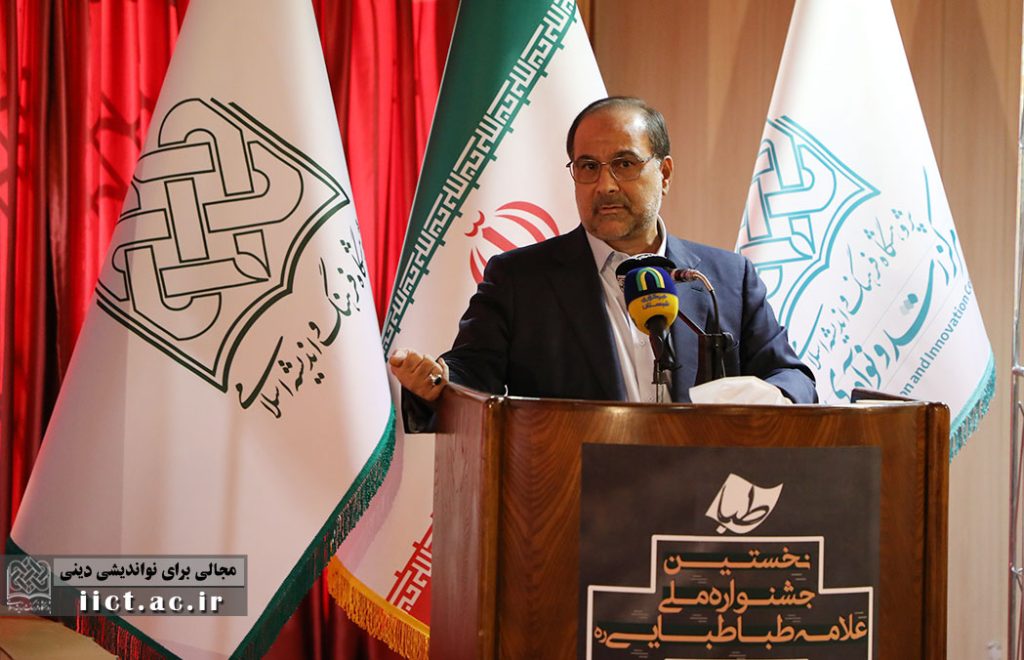
Tehran, Iran – Dr. Mohammad Reza Mokhber Dezfuli, the esteemed head of Iran’s Academy of Sciences, has outlined a compelling vision for the nation, emphasizing its strategic trajectory towards a “Strong Iran” and the establishment of a distinct civilizational model rooted in its unique ideological framework. Speaking at the closing ceremony of the “Taba National Event” at the Institute for Culture and Islamic Thought, Dr. Mokhber detailed Iran’s significant scientific and technological advancements as foundational to a future characterized by justice, independence, and a profound cultural identity.
Charting the Course for a ‘Strong Iran’
Dr. Mokhber initiated his address by highlighting the nation’s overarching strategic directive: the “Strong Iran” initiative, defined by the Leader. This grand strategy, he explained, serves as the driving force behind all current national endeavors, necessitating a cohesive, multi-sectoral approach where every domain contributes to unified national strength. A paramount objective within this framework, he noted, is for Iran to achieve leadership in science and technology, a path on which the nation has already embarked with remarkable momentum.
Remarkable Strides in Science and Technology
Underscoring Iran’s significant scientific prowess, Dr. Mokhber asserted that the country consistently ranks among the top 20 globally in cutting-edge technologies. He specifically cited fields such as nanotechnology, biotechnology, aerospace, stem cell research, advanced medical technologies, and organ transplantation, where Iran frequently stands among the world’s top 15 nations. These achievements, he added, transcend theoretical knowledge, encompassing the full cycle from “knowledge to product” and yielding substantial practical successes.
He further emphasized Iran’s entry into the exclusive global space club, demonstrating its capability to launch living organisms into Earth’s orbit and return them safely – a crucial precursor to human spaceflight. Dr. Mokhber stated that such indigenous capabilities signify Iran’s emergence as a “trans-regional and international power,” solidifying science and technology as an undeniable and continuous force within the country.
A New Civilizational Paradigm: Differentiating from the West
Dr. Mokhber drew a sharp distinction between Iran’s envisioned scientific and technological advancement and what he referred to as “Western technological civilization.” He characterized the latter as superficial, asserting that it detaches human reason from true happiness. He argued that since the Islamic Revolution, a new global movement has emerged, proposing a fresh narrative for human prosperity. This movement, he stated, is gradually laying its foundations within Iran, across Islamic countries, and among the world’s oppressed populations.
He acknowledged that building such a civilization is a long-term undertaking, but emphasized that significant strides have already been made in the 30-40 years since the Revolution. This new civilization, according to Dr. Mokhber, is fundamentally distinct: it is happiness-bringing, justice-oriented, anti-oppression, and a staunch supporter of the deprived, the oppressed, and nations striving for freedom and independence.
Challenging Global Hegemony and Advocating for Justice
In contrast to Iran’s emerging paradigm, Dr. Mokhber described “Western technological civilization” as inherently “dominating,” which, he contended, divides the world into “North and South.” He criticized international conventions for often making decisions for “Southern” nations, effectively treating them as second or third-class global citizens. This perceived inequality, he argued, is evident even in discussions concerning youth, children, women, and human rights.
He further linked the perceived shortcomings of this technological civilization to geopolitical actions, citing instances such as the bombing of civilians in Gaza and the forceful plundering of national resources. Dr. Mokhber also pointed to a history of global coups over the past 70 to 80 years, attributing many of them to this “dominating technological system.”
Ideological Foundations and Future Trajectory
To elevate Iran’s scientific and technological successes to their zenith, Dr. Mokhber stressed the imperative of an ethical, theoretical, epistemological, and civilizational foundation rooted in Islam. He called for greater contributions from specialists in these areas, acknowledging that this sector, while vital, is still developing. He underscored the vast, yet largely untapped, intellectual wealth within Islamic humanities and epistemology, describing it as a “deep treasure” awaiting extraction.
Dr. Mokhber identified the development of soft technologies, particularly those based on humanities, as a key method for effectively articulating Iran’s serious theories and fostering a conducive discursive environment. He expressed optimism for a newly established foundation, initiated by Professor Rashad and supported by several prominent figures, to strengthen this trajectory.
Concluding his remarks, Dr. Mokhber affirmed that these efforts represent a significant step, poised to initiate new developments that will judiciously advance Iran’s science and technology. He asserted that with such soft theoretical and cultural support, Iran’s successes would be exponentially magnified, ultimately guiding the nation toward the full realization of a “Strong Iran.”