Title: Tehran’s Real Estate at a Crossroads: Political Dynamics Reshape the Housing Market
A Market in Flux
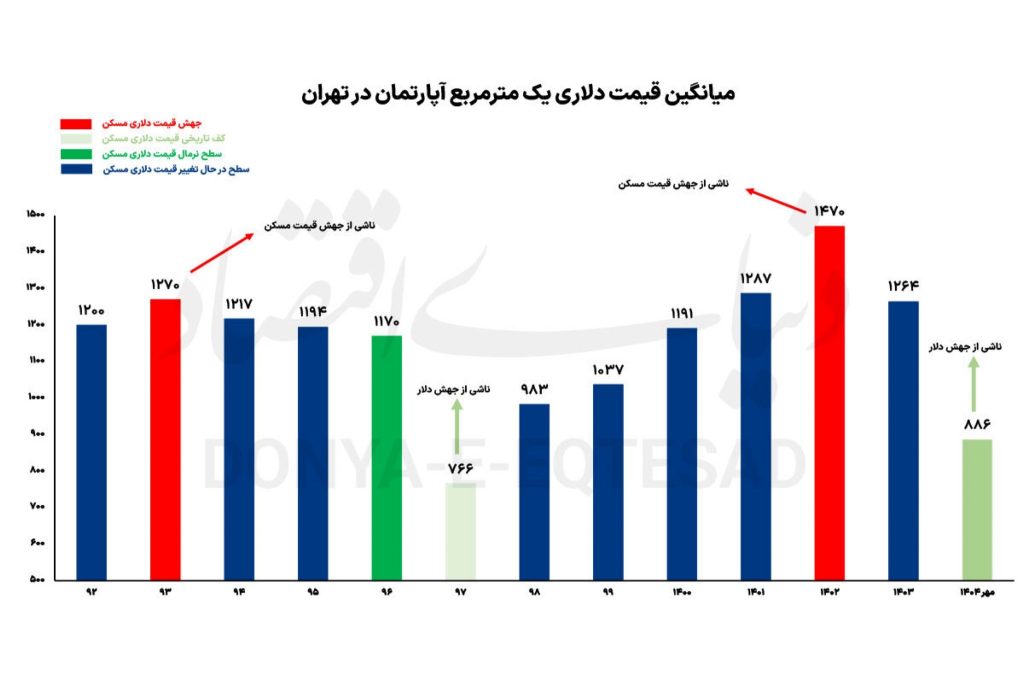
Tehran’s housing market is currently experiencing a significant shift, with the dollar-denominated price of apartments reaching its lowest point since the autumn of 2020. According to market analyses, the average asking price for an apartment in the capital has settled at approximately $886 per square meter. This figure, while still above the historic low of the past eight years, is notably 34% lower than the same period last year, signaling a departure from conventional market patterns.
The Political Decoupling
A detailed review of the market from 2017 to the present reveals a pivotal development: the recent decoupling of Tehran’s real estate prices from the foreign exchange market. For years, property expectations were closely tied to currency fluctuations. However, the activation of “war risk” in the region over recent months has created a significant divergence in how these two asset classes react to geopolitical tensions.
This separation has led to the dollar price per square meter receding from a peak of $1,470 in 2023 to around $1,264 in 2024, with the decline continuing into the current period. The result is a five-year low for the dollar value of apartments in Tehran, a phenomenon driven primarily by political factors that carry a clear message for the market’s future trajectory.
A Look Back: Political Shifts and Market Reactions
The market’s journey over the past several years highlights its sensitivity to the political climate:
- The Pre-2018 Era: Characterized by a stable economic environment, the dollar price of housing hovered around a normal level of $1,170.
- The Onset of Political Risk: Beginning in 2018, new political challenges led to a historic low of $766 for the dollar price of housing, as the currency market outpaced real estate.
- Periods of Negotiation: In years where diplomatic engagement offered prospects for resolving political and economic risks, the housing market saw moderated inflation and relative stability in its dollar price.
- The Recent Divide: The current phase, influenced by regional tensions, has seen a collapse in capital-driven demand for property. While other markets experienced volatility, the real estate sector entered a period of stagnation and falling dollar values.
Future Scenarios: The Political Roadmap
The outlook for Tehran’s housing market is intrinsically linked to the evolution of key political and economic variables, primarily “war risk” and international mechanisms like the “snapback” of certain agreements. Analysts outline three potential scenarios:
- Scenario One: Status Quo. Should the current ceasefire hold and existing political conditions persist, the dollar price of housing is expected to continue fluctuating below the $1,000 mark without reaching a new historic low.
- Scenario Two: Escalation. A significant escalation in regional tensions would likely drive the dollar price of housing even lower from its current level, as investment demand retreats further.
- Scenario Three: De-escalation. An improvement in the political atmosphere, potentially through diplomatic engagement that addresses current tensions, could reignite the market. This scenario would likely see a recovery in the dollar price of apartments as confidence returns.
The path forward for Tehran’s real estate is now firmly charted on a political map, with its recovery hinging on the resolution of external geopolitical factors.