Mysterious Death of Saif al-Islam Gaddafi Sparks Political Accusations in Libya
Introduction
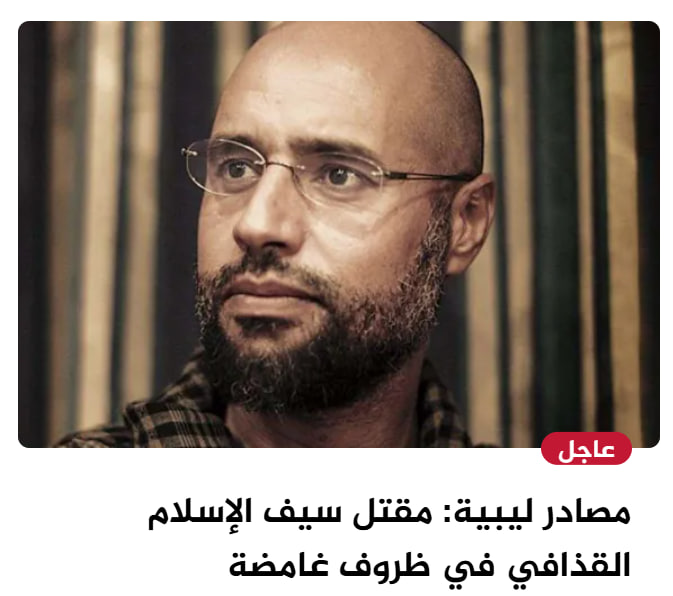
Libya has been plunged into fresh uncertainty following reports of the killing of Saif al-Islam Gaddafi, son of the late leader Muammar Gaddafi, in an armed attack in the western city of Zintan. The incident is shrouded in ambiguity, marked by conflicting narratives, immediate political accusations, and a notable silence from official institutions, highlighting the persistent fragility and deep divisions within the North African nation.
The Incident Unfolds
According to reports, including those from Al Jazeera, Saif al-Islam Gaddafi was killed in a mysterious shooting that occurred on Tuesday in Zintan, located southwest of the capital. While precise details surrounding the nature and circumstances of the attack remain elusive, his political advisor, Abdullah Othman, confirmed the death via his official account.
Initial reports from Al Jazeera’s correspondent in Tripoli indicated that four armed individuals stormed Saif al-Islam’s residence in Zintan, opening fire. This was reportedly followed by an armed confrontation between the attackers and other armed personnel present in the vicinity. There were also unconfirmed reports of injuries sustained by members of the “Abu Bakr al-Siddiq Battalion,” the very group that had arrested Saif al-Islam in 2011 and released him years later under a general amnesty law. It is understood that he had been living in an area populated by fighters from this battalion, ostensibly for his security. Intriguingly, some Libyan media outlets reported that surveillance cameras at the site were disabled prior to the incident, and Saif al-Islam was known to travel with stringent security measures.
A Web of Contradictions and Blame
The immediate aftermath of the alleged killing saw a flurry of political accusations and contradictory accounts, underscoring the fragmented nature of Libya’s security and political landscape. A supporter of the former regime reportedly claimed that “elite units” linked to Khalifa Haftar were responsible for the assassination, engaging in clashes with Gaddafi’s son’s guards. This claim was relayed by Al Jazeera’s correspondent.
Conversely, some sources suggested that Saif al-Islam had been moving freely within Zintan and the surrounding desert areas, having strengthened his ties, and even forged kinship, with his former captors in Zintan. This contrasts with earlier tensions reported about ten days prior to the incident, where clashes erupted in Zintan between his supporters and opponents linked to the 2011 revolution, with the latter demanding his handover to the International Criminal Court (ICC) or his departure from the city.
Further muddying the waters, initial reports surfaced of a clash involving Brigade 444, affiliated with the Tripoli government, in the Al-Hamada desert. However, the brigade swiftly denied any involvement, stating it had no role in Saif al-Islam’s death and was not pursuing him. The ambiguity surrounding the death of this controversial figure, who maintained a low-profile but mysterious presence after his release, reportedly possessed some military capability in the Al-Hamada desert, and constantly feared re-arrest or aerial targeting, persists.
Saif al-Islam’s Contentious Political Journey
Born in 1972, Saif al-Islam was the second son of Muammar Gaddafi. After graduating from Tripoli University and pursuing studies in Europe, he began to play significant, albeit unofficial, roles in Libyan domestic and foreign policy from 2000, leading negotiations on sensitive issues. In 2006, he launched the “Libya Tomorrow” reform project, widely perceived at the time as an attempt to facilitate a hereditary transfer of power.
Following the outbreak of the February 17, 2011 revolution, he emerged as a principal defender of his father’s regime, making televised appearances to condemn revolutionaries as “foreign agents” and “traitors.” He was arrested on November 19, 2011, near Ubari and subsequently held in a Zintan prison. Despite repeated demands from the ICC for his transfer to face charges of war crimes and crimes against humanity, Libya refused his extradition. Libyan courts held multiple sessions to try him on charges of corruption and war crimes, culminating in an in absentia death sentence by firing squad issued by the Tripoli Court of Appeal on July 28, 2015.
However, his lawyer announced in July 2016 that Saif al-Islam had been released in April of that year under a general amnesty law, having spent five years in prison, and was residing within Libya. His unexpected return to the political spotlight came on November 18, 2021, when he announced his candidacy for the presidential elections in Sebha, appearing under heavy security.
Implications and Official Response
The reported killing of Saif al-Islam Gaddafi adds another layer of profound complexity to Libya’s already fractured political landscape and ongoing efforts toward stability and national reconciliation. His advisor stated that the Libyan Prosecutor General has initiated an investigation into the incident, asserting that Saif al-Islam had neither armed forces nor local animosity in Zintan. The broader official silence from other state institutions, amid the flurry of conflicting reports and political accusations, further underscores the deep-seated divisions and the persistent challenges facing Libya’s future.