Trump Presses European Allies for Naval Support in Strait of Hormuz Amid Energy Crisis
Washington D.C. – U.S. President Donald Trump has reportedly urged European Union leaders to commit to a mission aimed at ensuring free navigation through the Strait of Hormuz, according to informed sources speaking with Reuters. The call for tangible commitments comes as the crucial waterway, vital for approximately 20% of the world’s oil and natural gas, faces significant disruption, fueling global energy price hikes and concerns over potential shortages.
A Diplomatic Push for Maritime Security
Sources indicate that Trump is seeking swift action from his European counterparts. This diplomatic initiative follows President Trump’s announcement of a two-week ceasefire agreement between Washington and Tehran. Hours later, Iran’s Supreme National Security Council declared a significant diplomatic victory, asserting that Washington had agreed to Tehran’s ten-point plan. This plan, as outlined by Iran, reportedly includes principles such as non-aggression, continued Iranian control over the Strait of Hormuz, acceptance of Iran’s enrichment activities, the lifting of all primary and secondary sanctions, the termination of all UN Security Council and IAEA resolutions, compensation for damages to Iran, the withdrawal of U.S. combat forces from the region, and a halt to hostilities across all fronts, including support for Hezbollah.
Iranian Foreign Minister Seyed Abbas Araghchi has stated that safe passage through the Strait of Hormuz will be feasible during the two-week period through coordination with Iran’s armed forces and with consideration for technical limitations. However, analysts suggest that even an immediate reopening of the Strait may not rapidly de-escalate the current crisis.
NATO’s Evolving Role and U.S. Expectations
Concurrently, Germany’s Handelsblatt newspaper has reported that the North Atlantic Treaty Organization (NATO) is exploring a maritime mission to uphold “freedom of navigation” in the Strait of Hormuz. Sources familiar with the matter told the German newspaper that such a mission could commence as a coalition of volunteer nations before potentially being transferred to NATO command at an upcoming summit in Ankara.
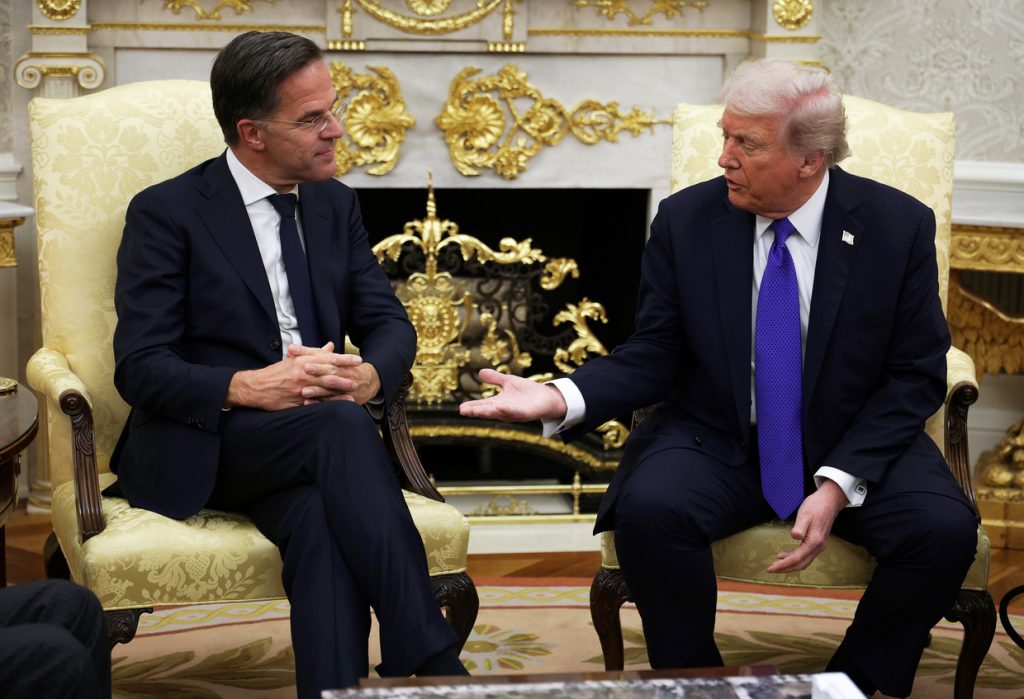
The news of Trump’s push for European support comes after a meeting with NATO Secretary General Jens Stoltenberg at the White House. Following this meeting, President Trump publicly criticized the military alliance for what he perceives as a lack of willingness to participate in broader regional security efforts. Trump voiced his dissatisfaction on his social media platform, Truth Social, stating that NATO was absent when needed and may not be present in future crises.
Prior to the meeting, White House Press Secretary Karine Jean-Pierre had indicated that Trump would engage in a “very frank and direct conversation” with the NATO chief, asserting that European nations had failed to meet their defense commitments to the American people. These remarks have fueled speculation in Western capitals about the potential for Washington to reassess its engagement with the transatlantic alliance, which Trump has previously referred to as a “paper tiger.” Several NATO members had previously declined to open their airspace to U.S. military aircraft or deploy naval assets to assist in the reopening of the Strait of Hormuz, a critical energy chokepoint that has been effectively closed since the escalation of regional tensions in late February, contributing to a global energy crisis.