Iran’s Political Pulse on X: Public Fatigue with Diplomacy, US Strategy Dissected Amidst Calls for Regional Security
In today’s dynamic political landscape, social media platforms have emerged as critical tools for political and social communication, with many Iranian officials and analysts frequently utilizing ‘X’ (formerly Twitter) to articulate their viewpoints, positions, and decisions. A recent aggregation of prominent daily tweets offers a window into the multifaceted discussions shaping Iran’s domestic and foreign policy discourse.
Proposed Framework for US-Iran Accord Sparks Debate
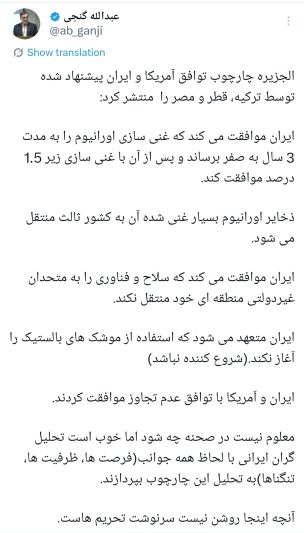
Abdullah Ganji, a political commentator, shared details from Al Jazeera concerning a proposed framework for a US-Iran agreement, reportedly put forth by Turkey, Qatar, and Egypt. The suggested terms include Iran agreeing to cease uranium enrichment for three years, followed by a limit of below 1.5%. Additionally, Iran’s highly enriched uranium reserves would be transferred to a third country. The framework also proposes Iran refraining from transferring weapons and technology to non-state regional allies and committing not to initiate ballistic missile use. A mutual non-aggression pact between Iran and the United States was also part of the suggested deal. Ganji urged Iranian analysts to thoroughly evaluate this framework, noting the critical ambiguity surrounding the future of sanctions.
In a separate tweet, Ganji critically questioned the selective coverage of certain media outlets, asking why a particular channel, which he referred to as “Mossad International,” was not reporting on what he described as a “super moral and sexual catastrophe of the West.”
Negotiation Stance and Media Scrutiny
Ali Shafieian addressed comments made by JD Vance, underscoring the legitimacy of Iran’s negotiators irrespective of internal governmental structures. Drawing parallels with historical Iranian political arrangements and contemporary monarchies, Shafieian asserted that the negotiating representative fully embodies Iran’s stance, urging against peripheral discussions and emphasizing the finite window for diplomatic engagement.
Further insight into international dynamics came from Ali Bahadori Jahromi, who analyzed former US President Donald Trump’s media strategy. Jahromi characterized Trump’s public statements and tweets as a calculated method for public opinion management, often serving what Jahromi termed “Zionist lobbies.” He specifically highlighted “fickleness or pretending to be so” as a defining feature of Trump’s media approach.
Mehran Ranjbaran echoed a perspective of Iranian resolve, asserting that the US had acknowledged Iran’s determination and seriousness, leading to what he described as a retreat. He suggested that any assertive statements from figures like Trump would merely be a show of “superpower pretense,” and expressed hopes for the success of Iran’s negotiators in achieving favorable outcomes.
Public Weariness and Calls for Decisive Diplomacy
A significant intervention came from Gholamhossein Karbaschi, who, in a direct address to Mojtaba Pezeshkian, articulated widespread public fatigue with the prolonged negotiation process. Karbaschi stated that after “more than 20 years” of ongoing talks, the very word “negotiations” had become tiresome for the populace, whose daily lives are intrinsically linked to these developments. He earnestly called for an end to what he termed this “cat and mouse game,” urging for decisive action to resolve the protracted diplomatic efforts.
Rethinking Regional Security and Domestic Rights
Abbas Akhoundi presented a strategic foreign policy perspective, arguing that negotiations with the US, while necessary, are insufficient. He advocated for a parallel initiative aimed at forging a credible, long-term collective regional security vision involving cooperation with China and other regional nations. Akhoundi stressed that current diplomatic endeavors would remain ineffectual without a fundamental “discourse change” and a “paradigm shift” in understanding global foreign policy realities. Such a shift, he contended, is crucial for guaranteeing the collective security of the Persian Gulf region, safeguarding global value chains, and protecting the interests of all regional actors.
Domestically, Mahmoud Sadeghi took to X to reaffirm the fundamental nature of civil liberties. He underscored that the right to protest, assembly, and demonstration should be formally recognized as a basic civil right, citing Article 27 of the Iranian Constitution, the Universal Declaration of Human Rights, and the International Covenant on Civil and Political Rights, all of which Iran is obligated to uphold.
National Unity in the Face of Adversity
Malek Shariati emphasized a message of national unity and patriotism. He conveyed that all Iranians, regardless of their political, ethnic, or religious affiliations, mourn those who lost their lives during what he described as a “recent failed American-Zionist coup” and the defenders of the people, while also expressing sadness for the fate of “enemy mercenaries.” Shariati concluded by asserting that a true patriot would never permit their sorrow to be exploited by “Iran’s secessionist enemy.”
These diverse social media exchanges highlight the ongoing, robust political discourse within Iran, reflecting a range of views on critical international and domestic issues, and underscoring the evolving role of digital platforms in shaping national dialogue.