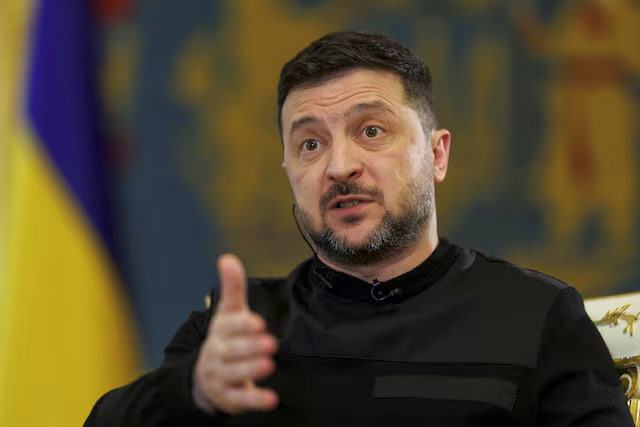
Russia’s Alleged Intelligence Gambit: Zelensky Claims Moscow Sought Leverage Over US
Kyiv, Ukraine – Ukrainian President Volodymyr Zelensky has accused Russia of attempting to blackmail the United States by offering to cease its military intelligence sharing with Iran, provided Washington halts its own intelligence provision to Kyiv. Zelensky asserted that this alleged maneuver is a direct consequence of regional tensions and aims to exploit vulnerabilities in transatlantic relations.
Strategic Information Exchange Under Scrutiny
Speaking to Reuters, President Zelensky stated that his intelligence services possess “irrefutable” evidence of Russia’s ongoing information sharing with Iran. He claimed to have personally reviewed this data, though he refrained from divulging specific details. Zelensky also alleged that some Iranian drones used in attacks against military assets belonging to the US and its allies in the Middle East during the ongoing conflict contained Russian components.
“I have reports from our intelligence services indicating that Russia is doing this and saying, ‘If America stops sending information to Ukraine, I will not transfer information to Iran.’ Is this not blackmail? It absolutely is,” Zelensky remarked, characterizing the alleged Russian proposal as a clear attempt to exert pressure.
The Ukrainian President did not specify who within Russia purportedly communicated these terms. Russia has consistently denied providing assistance to Iran in its conflicts, a denial that the US confirmed receiving directly from Moscow earlier this month.
Reports of a Diplomatic Proposal
This latest claim echoes a recent report by Politico, which alleged that Moscow had proposed to Washington that, in exchange for the cessation of Russian-related intelligence sharing with Ukraine, the Kremlin would also stop sharing information with Iran, such as precise coordinates of US military assets in the Middle East.
Sources familiar with US-Russia diplomatic channels suggested that such an offer was made by Kirill Dmitriev, a Russian envoy, to Steve Witkoff and Jared Kushner, envoys for the Donald Trump administration, during a recent meeting in Miami. These sources, who requested anonymity, indicated that the US rejected the proposal.
European Concerns Over Transatlantic Divides
The purported Russian offer has reportedly raised concerns among European diplomats, who fear that Moscow is attempting to sow discord between Europe and the United States during a critical juncture for transatlantic alliances. One European diplomat described the alleged Russian proposal as “shameful.”
This alleged deal is seen by some as potentially exacerbating existing suspicions in Europe: that meetings between figures like Witkoff and Dmitriev are not aimed at achieving a tangible peace agreement in Ukraine but are instead being used by Moscow as an opportunity to draw Washington into a bilateral understanding that could sideline European interests.
The Kremlin has categorically denied the Politico report.
Intelligence Sharing: A Vital Lifeline
Despite the alleged complexities, the US has continued to share intelligence with Ukraine, even as other forms of support have faced reductions. The US had briefly suspended these exchanges last year, a move that reportedly caused disruption and highlighted deep-seated tensions in its cooperation with Kyiv.
However, a European diplomat sought to mitigate concerns about the Russian proposal’s potential impact, noting that French President Emmanuel Macron had previously stated that “two-thirds” of Ukraine’s military intelligence was being supplied by France.
Nevertheless, following the Trump administration’s substantial pause on financial and military aid to Kyiv last year, intelligence exchanges remain a critical pillar of American support for Ukraine. While Washington continues to supply weapons, it now operates under a NATO-led framework where allies bear the cost of military equipment. Notably, deliveries of crucial air defense ammunition have reportedly faced pressure amidst the ongoing conflict between the US and Israel against Iran.
The Trump administration’s recent decision to ease sanctions on Russian oil, purportedly to alleviate pressure on global oil markets, has also drawn significant concern and criticism from European leaders.