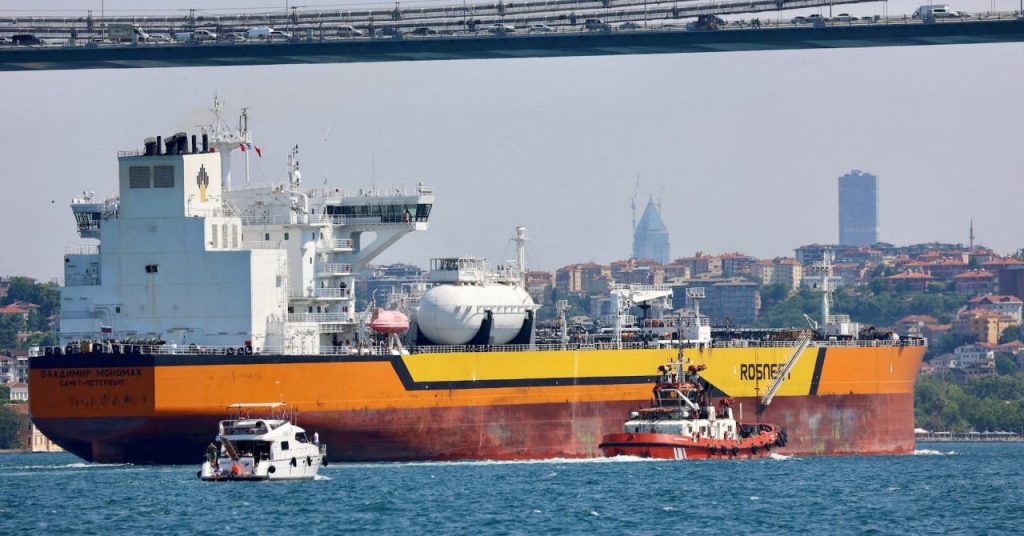
Global Energy Flux: Russia’s Oil Revenue Surges Amidst Geopolitical Tensions
Moscow’s oil tax revenue is projected to reach $9 billion in April, a substantial increase driven by the global energy crisis, according to Reuters calculations. This financial uplift comes as international markets grapple with disruptions, highlighting Russia’s significant role in the global energy landscape.
Key Developments:
Reuters’ exclusive analysis reveals a dramatic uptick in Russia’s oil tax revenue for April, projected to hit $9 billion. This figure represents a more than twofold increase compared to March. Oil tax, levied on Russian companies for the extraction, production, or export of oil, forms a crucial component of the nation’s fiscal income.
The surge in revenue is closely linked to the recent escalation of tensions in the Middle East. Following heightened maritime security measures in the Strait of Hormuz, a vital artery for global energy transport, by Iran in response to military actions, oil prices have experienced significant volatility. This has, in turn, boosted the value of Russian Urals crude.
Economic Impact and Market Dynamics:
The price of Russia’s Urals crude saw a substantial jump of 73% in March compared to February, reaching $77 per barrel. This marks the highest point since October 2023 and surpasses the government’s budgetary projection of $59 per barrel for the current year. Traders have characterized the current energy crisis as one of the most severe in contemporary history, with implications rippling across international markets.
For Russia, whose primary revenue from its vast oil and gas sector is production-based, these market shifts present a notable financial benefit. Export duties on crude oil have been zeroed out since the beginning of 2026 as part of broader tax reforms within the industry.
Revenue Projections and Future Outlook:
Reuters’ calculations, based on preliminary production and price data, estimate Russia’s mineral extraction tax on oil production to reach approximately 700 billion rubles ($9 billion) in April. This compares to 327 billion rubles in March and represents an approximate 10% increase from April of the previous year. For the entirety of 2026, Russia has projected 7.9 trillion rubles in revenue from mineral extraction taxes.
The Kremlin has acknowledged a considerable global demand for Russian energy resources amid the prevailing global energy crisis. However, this financial windfall is not without its complexities. Russian economists have previously cautioned that 2026 could present economic challenges.
Challenges and Strategic Considerations:
Despite the current revenue surge, Russia’s Ministry of Finance reported a budget deficit of 4.58 trillion rubles (1.9% of GDP) for the period of January to March 2026. Furthermore, ongoing disruptions to Russian energy infrastructure, stemming from the conflict in Ukraine, pose a threat to production levels and revenue streams. These multifaceted challenges underscore the delicate balance Russia navigates in the global energy arena.